- AI for Ecommerce and Amazon Sellers
- Posts
- Your Org Chart Is the AI Bottleneck
Your Org Chart Is the AI Bottleneck
(And Nobody Wants to Admit It)
In partnership with


From Our Sponsor:
Rex Gelb spent a decade building HubSpot's paid engine. Now he's showing founders exactly how to do it.
On April 27th, get the framework to structure, launch, and scale paid media that drives pipeline, not just traffic. 20 minutes. Live Q&A. Free.
Your Org Chart Is the AI Bottleneck (And Nobody Wants to Admit It)
Everyone's talking about AI adoption. CEOs are sending all-hands emails about it. LinkedIn is drowning in "how we integrated AI into our workflow" posts from people who mostly used ChatGPT to rewrite their bio. But here's a stat that should make every ecommerce operator pause mid-scroll: more than 80 percent of companies say they're not seeing bottom-line impact from their AI investments.
Eighty. Percent.
That's not a technology problem. The models work. The tools are genuinely impressive. This is an organisational architecture problem — and it's one that most companies are aggressively ignoring in favour of buying more software licences and hoping for the best.
McKinsey just dropped research on organisational readiness for agentic AI, and buried in the consultant-speak is a conclusion that's both obvious and wildly uncomfortable: the companies failing at AI aren't failing because they picked the wrong tools. They're failing because their org charts were designed for a world that no longer exists.
The Faster Horse Problem (Now With More AI)
Most ecommerce businesses are approaching AI the way you'd approach getting a faster horse: same roads, same destinations, just... speedier. Using AI to draft listing copy a bit quicker. Generating ad creative variations without waiting on a designer. Pulling competitor pricing data faster than a VA could.
All useful. None of it transformational. Because the underlying organisational scaffolding — the approval chains, the departmental silos, the weekly status meetings that exist to move information between people who should already have it — remains completely untouched.
McKinsey's research puts a number on why this matters: most companies have added at least one additional management layer over the past decade. Some have added two or three. Each layer adds cost and, more critically, slows everything down because more people need to weigh in before anyone can actually do anything. (If you've ever waited two weeks for sign-off on a product listing update that took four minutes to write, you know exactly what I'm talking about.)
The companies seeing real returns aren't automating individual tasks within the same structure. They're asking whether the structure itself should exist in its current form. That's a fundamentally different — and much more uncomfortable — question.
From Managing People to Managing Populations
Here's where we need to get concrete about what this actually looks like inside an ecommerce operation, because the theoretical stuff is easy. The practical stuff is where everyone gets stuck.
The old model: a PPC manager runs your Amazon advertising. They pull search term reports, adjust bids, monitor ACoS, test new keywords, analyse competitor positioning, and report performance weekly. One person, one function, lots of manual data wrangling.
The emerging model: that same person is now managing a portfolio of AI agents. One agent monitors search term performance continuously and flags anomalies. Another runs bid adjustments within pre-set guardrails. A third tracks competitor listings for pricing changes, new entrants, and positioning shifts. A fourth analyses the relationship between your organic rank and your ad spend by keyword cluster.
The human isn't doing the pulling, adjusting, and monitoring anymore. They're doing the thinking. They're the strategist overseeing a small army of specialist agents, each handling a narrow task with high speed and consistency, while the human provides the judgment calls: should we pivot budget from this keyword cluster to that one? Is this competitor move a real threat or noise? Does this data pattern suggest a market shift we need to get ahead of?
This isn't a subtle shift. It's a complete redefinition of what the role actually is. And it applies across every function in an ecommerce business — supply chain, content, customer service, marketplace management, the lot.
Building Your Second Brain (No, Seriously)
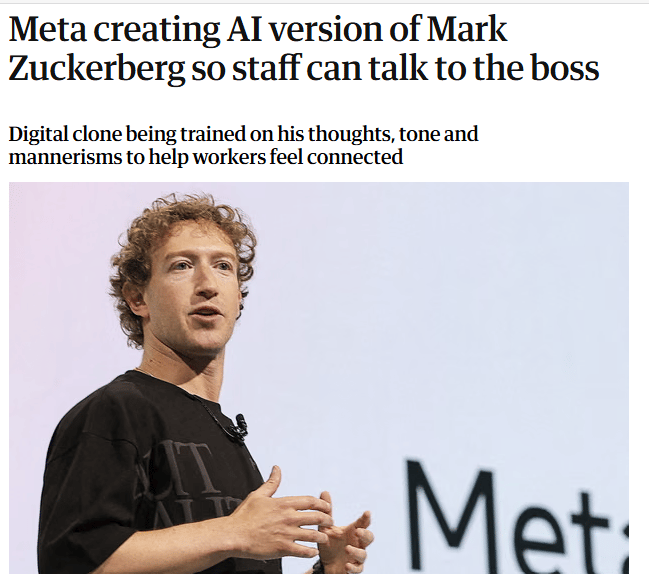
If you manage people, have you built your own AI version? Might be a time saver. Source: The Guardian
Here's the thing that most AI adoption conversations miss entirely: it's not just about deploying agents to do tasks. It's about each person in your organisation building what amounts to a personalised AI advisory team — a second brain that helps them think better, not just execute faster.
Picture your category manager. Today, they might be decent at pricing strategy but weaker on content optimisation, and they probably haven't touched a supply chain forecast since that one training session three years ago. In the emerging model, that same person has AI systems that function as specialist advisors across multiple disciplines. One acts as a pricing strategist, constantly stress-testing their margin assumptions against market data. Another functions as a content analyst, reviewing their listings against top performers and surfacing specific gaps. A third serves as a demand planning advisor, flagging when sell-through rates suggest they need to adjust purchase orders.
The category manager hasn't suddenly become an expert in content strategy and demand planning. But they've built a multi-disciplinary thinking team around themselves that catches blind spots, challenges assumptions, and surfaces connections that a single human brain would miss.
This is where the role becomes genuinely multi-disciplinary. Your listing specialist isn't just writing copy anymore — they're orchestrating agents that analyse search behaviour, test content variations, monitor conversion impact, and cross-reference competitor positioning. They're still making the creative calls, but informed by analysis that previously required three separate people and a two-week turnaround.
The practical implication? Every person in your ecommerce operation should be building their own constellation of AI agents — their own second brain — tailored to their specific role and responsibilities. Not waiting for IT to deploy a company-wide tool. Not hoping the new platform has the right features. Actively constructing the AI support system that makes them dramatically more effective.
The Token Budget Nobody Planned For
Here's where the economics get properly weird. For years, the standard marketing budget split has been remarkably stable: roughly 45 percent headcount, 45 percent programmes, 10 percent technology. That ratio is shifting, with technology allocations climbing two to three percentage points year on year.
But the genuinely novel challenge isn't software licensing. It's tokens.
Token costs — the consumption-based pricing that underpins most AI usage — don't behave like anything we've budgeted for before. They scale with usage, and when every person in your org is running multiple agents across multiple functions, that usage compounds fast. It's like discovering that the electricity bill for your warehouse has suddenly become a strategic cost centre that needs its own forecasting model.
Nvidia CEO Jensen Huang recently suggested that engineers will soon negotiate how many tokens come with their job alongside salary — partly because Nvidia already expects its engineers to consume roughly half their salary equivalent in tokens. Half. Their. Salary. In tokens.
For ecommerce businesses where margins are already under pressure from rising media costs, declining organic traffic, and platform fees, this isn't a nice-to-know. You need frameworks for forecasting, monitoring, and governing token spend the same way you manage ad spend — with clear visibility into ROI and usage patterns by team, by function, by agent.
(Which means someone's going to have to build the "token dashboard." I'm sorry. I don't make the rules.)
What Redesign Actually Looks Like at Different Scales
For smaller operations (under 20 people), the advantage is minimal layers to compress. The priority: every team member actively building their agent ecosystem, with clear lines between where agents operate autonomously — inventory alerts, customer service triage, listing optimisation drafts — and where human judgment is non-negotiable: brand positioning, supplier relationships, strategic pricing.
For mid-sized businesses (20 to 200), this is where it gets properly painful. Enough structure to create real friction, not enough resources for a massive transformation programme. The critical move: identify two or three end-to-end workflows — product launch from sourcing through listing to advertising, returns from complaint through to restock decision — and deploy AI across the full process, not just at individual touchpoints.
McKinsey's research suggests 75 percent of roles require fundamental reshaping in the near term. That's not a training programme. That's a rethinking of what "good" looks like when every employee is managing agents alongside their human responsibilities.
For larger organisations (200-plus), you need governance frameworks for how agents are built, deployed, monitored, and retired. Shared infrastructure rather than each department building bespoke solutions that can't talk to each other. (Because nothing says "we've embraced AI" quite like seventeen incompatible AI implementations across the same company.)
The Leadership Gap That's Actually the Whole Problem
Here's the part that's going to sting: nearly half of leaders say they see significant skill gaps in their organisations. But the more consequential gap is at the leadership level itself.
Leaders making the structural decisions about AI adoption often aren't modelling the behaviour they expect. They're not building their own agent ecosystems. They're not fundamentally rethinking how they spend their working hours. They're using AI to tighten an email and calling it transformation.
One executive quoted in McKinsey's research put it bluntly: if this technology will radically transform the business, the leadership team needs to start by radically transforming itself. Not 5 percent of the day augmented by AI. Fifty percent.
And there's a downstream problem that's properly tricky: if AI handles the research, data analysis, and pattern recognition that junior employees traditionally cut their teeth on, how do those employees develop the judgment required for senior roles? When your junior marketplace analyst has agents doing the data pulling and trend spotting, what's the new apprenticeship model? How do they build the instinct that later becomes strategy?
The answer probably involves learning by managing and directing agents rather than doing the manual work itself — developing judgment through the quality of the questions they ask their AI systems, not the spreadsheets they build by hand. But we're figuring this out in real time. Nobody has a playbook for it yet.
The Bottom Line for Sellers
Competitive advantage used to be about execution speed — who could ship fastest, list fastest, optimise fastest. Now it's about learning speed — how quickly your organisation can absorb what AI makes possible and restructure around it.
The companies that pull ahead won't be those with the biggest AI budgets or the fanciest models. They'll be the ones willing to ask the uncomfortable structural questions. Not "how do we use AI to do what we already do, faster?" but "what does every role in this business look like when each person is managing a team of AI agents and building their own multi-disciplinary advisory system?"
Most companies are still using AI the way you'd use a faster horse. The ones that define the next era of ecommerce are those willing to redesign the roads.
P.S. If you're reading this thinking "we should probably look at our org structure," you're already ahead of 80% of companies. The bar is, unfortunately, on the floor.
P.P.S. If you're reading this thinking "our org structure is fine, we just need better tools," I have some unfortunate news about that 80% statistic.
Do You Love The AI For Ecommerce Sellers Newsletter?
You can help us!
Spread the word to your colleagues or friends who you think would benefit from our weekly insights 🙂 Simply forward this issue.
In addition, we are open to sponsorships. We have more than 66,000 subscribers with 75% of our readers based in the US. To get our rate card and more info, email us at [email protected]
The Quick Read:
Google looks set to expand Gemini Skills into AI Studio, giving users reusable instructions plus scheduled workflows and pushing Gemini closer to a true agent platform.
READ THIS: Daniel Kokotajlo’s 2021 vision of 2026 looks eerily on target, with agent scaffolding, AI revenue booms and chip wars landing close enough to make his next forecasts hard to ignore.
AI can code, reason and design, but great writing still slips through its fingers, with today’s models polished enough to impress yet rarely sharp enough to truly move a reader.
Amazon’s new Buy for Me feature turns its app into an agentic shopping layer, letting customers purchase from brand sites through Amazon even when the item is not sold on Amazon itself.
Upwork is moving inside ChatGPT, letting businesses describe a need, surface talent and draft job posts in one thread before handing off to Upwork to close the hire.
Adobe says AI traffic to U.S. retail sites is soaring and now converts better than human traffic, making AI visibility less of a nice to have and more of a revenue channel.
Agentic Engine Optimization is emerging as the new SEO for docs, helping brands structure content so AI coding agents can actually find, parse and use it instead of hallucinating around it.
The Tools List:
📖 Stori AI: Create and publish branded content effortlessly. Reach your audience across multiple channels and make a lasting impression.
📊 Simple Analytics: Get insights about your business by chatting with your analytics in real-time using AI.
🖺 Jaquard: AI tool for enterprise marketers, optimising content across digital channels with performance prediction and brand controls.
🔎 Search+ - Chat with any PDF documents
🦔 Keepi - A personal knowledge assistant
About The Writer:

Jo Lambadjieva is an entrepreneur and AI expert in the e-commerce industry. She is the founder and CEO of Amazing Wave, an agency specializing in AI-driven solutions for e-commerce businesses. With over 13 years of experience in digital marketing, agency work, and e-commerce, Joanna has established herself as a thought leader in integrating AI technologies for business growth.
For Team and Agency AI training book an intro call here.