- AI for Ecommerce and Amazon Sellers
- Posts
- You Can Now Run Meta Ads From Claude and ChatGPT.
You Can Now Run Meta Ads From Claude and ChatGPT.
Here's How.

Jo Lambadjieva
May 13, 2026
In partnership with


From Our Sponsor:
We hired one colleague for every department.
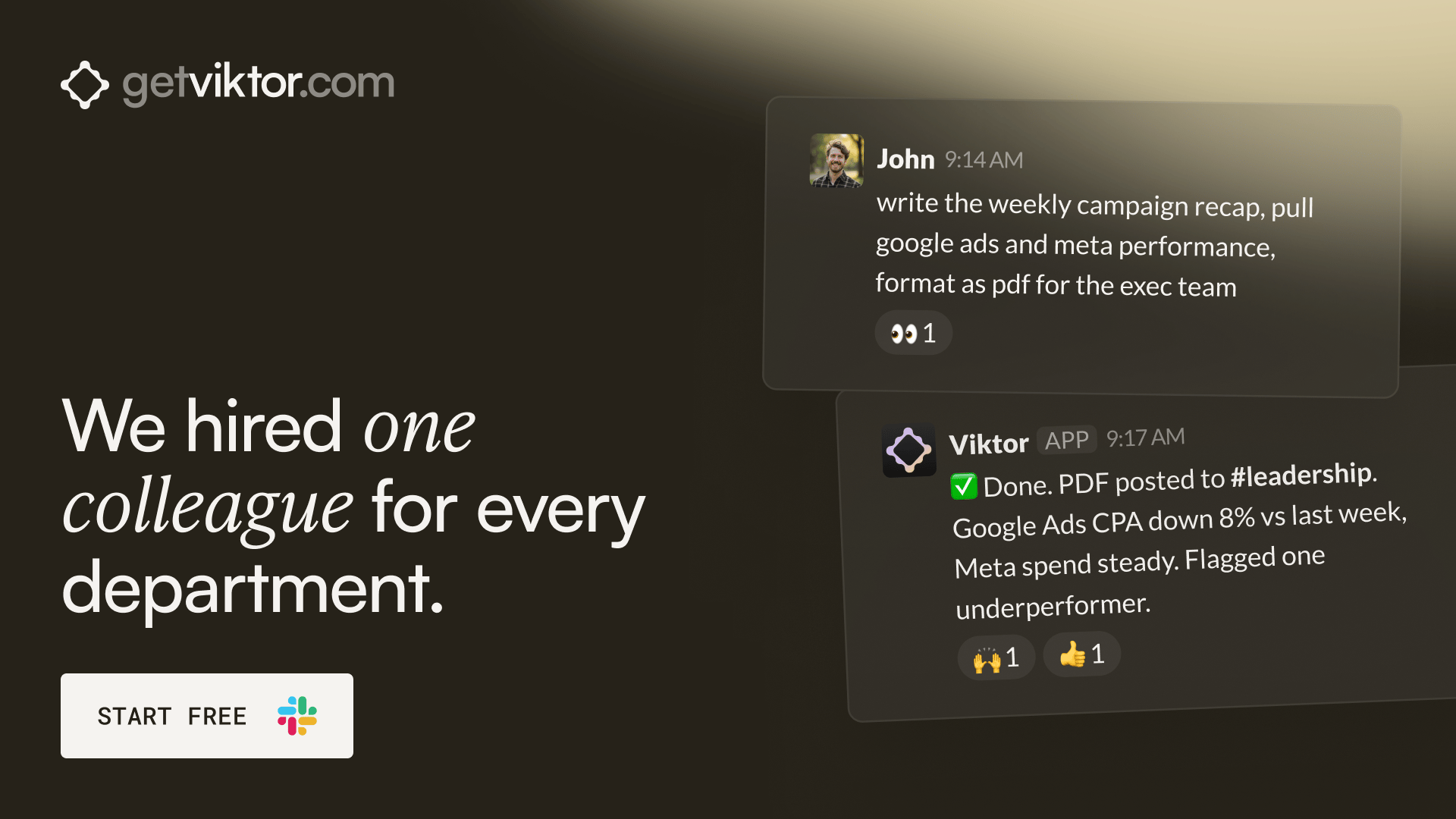
Last Tuesday, marketing asked Viktor to write the weekly campaign recap, pull performance from Google Ads and Meta, and format it as a PDF for the exec team. Done in four minutes.
That same afternoon, engineering asked Viktor to review three open pull requests on GitHub, cross-reference with the Linear sprint board, and flag anything blocking the release. Posted to private channel before standup.
At 9pm, ops asked Viktor to draft a vendor contract summary from three Notion docs and send it to the team. It was in #ops by morning.
None of them knew the others were using it.
Same colleague. Three departments. That's what changes when your AI coworker lives in Slack, where your whole company already works. It's not a tool one person logs into. It's a teammate everyone messages.
5,700+ teams. SOC 2 certified. Your data never trains models.
"Viktor is now an integral team member, and after weeks of use we still feel we haven't uncovered the full potential." - Patrick O'Doherty, Director, Yarra Web
You Can Now Run Meta Ads From Claude and ChatGPT. Here's How.
Meta has opened its advertising system to Claude, ChatGPT, and Perplexity through the Model Context Protocol. You can now manage your Meta campaigns by talking to an AI assistant instead of clicking through Ads Manager. This is either the most useful thing Meta has done in years, or a trust exercise nobody asked for. Possibly both.
Here's what happened: Meta launched AI Connectors in open beta to eligible advertisers globally, and the setup is almost suspiciously easy. You connect your ad account to an AI tool via a single URL — mcp.facebook.com/ads — authenticate through Facebook Login, and suddenly Claude or ChatGPT can access 29 different tools spanning performance reporting, anomaly detection, campaign creation, and product catalogue management. The whole process takes less than five minutes, which is roughly how long it takes to load a single Ads Manager report on a bad day.
For those of us running ecommerce campaigns across multiple platforms, this is the latest confirmation of something we've been tracking all year: MCP is becoming the universal language between AI tools and advertising infrastructure. Amazon's done it. Google's done it. Shopify's done it. Meta was, frankly, the last major holdout. (Fashionably late, as always.)
Why Meta Is Being So Generous (Spoiler: They're Not)
Let's think about what Meta is actually doing here. This is a company that has spent years herding advertisers deeper into its own ecosystem — Advantage+ campaigns, its own creative tools, its own reporting dashboards, its own reality where all your metrics look fantastic until you check your bank account. Letting advertisers manage campaigns through third-party AI tools looks, on the surface, like an uncharacteristic act of openness.
It is not.
As Jacob Bourne, technology analyst at eMarketer, put it: Meta wants more advertisers on its platforms, and opening the door to third-party AI tools keeps them tied to the ecosystem. Think about it — your workflow might run through Claude now, but every action still executes against Meta's ad infrastructure. You haven't escaped Meta. You've just found a more comfortable chair in their waiting room.
The timing is also worth noting. This launch comes amid tension around Meta's acquisition of Manus, the Chinese-founded AI agent company — a deal Chinese authorities have ordered unwound — and broader industry scrutiny about whether Meta is too controlling in the AI space.The decision to allow third-party integrations may be partly about getting ahead of those optics.
And then there's the part nobody at Meta wants you to dwell on: just two months before this launch, advertisers reported unexplained account shutdowns after integrating third-party AI tools with Meta's systems. No official connection was confirmed, but the timing is the kind of coincidence that makes you quietly screenshot everything before connecting your account. Meta is now officially inviting the exact category of integration it appeared to penalise weeks earlier. That particular brand of corporate whiplash deserves a slow clap.
MCP: The Protocol That Ate Advertising
If you've been reading this newsletter for a while, you already know where this is heading. We covered Amazon's Ads MCP server when it launched. We published an in-depth guide to how MCP works and why ecommerce operators should care. Meta's connector is just the latest domino.
But here's where the cumulative picture gets genuinely interesting. A seller running campaigns across Meta, Amazon, and Google can now, in principle, manage all three through the same AI interface using the same protocol. Instead of switching between three dashboards with three different reporting structures (each designed, apparently, by someone who actively dislikes the people using them), you can ask a single AI assistant to pull performance data across all of them, flag where your budget is underperforming, and surface anomalies that would take hours to find manually.
This isn't a roadmap slide at a developer conference. The infrastructure is live. Whether you're using it is a different question.
Setting It Up (It's Almost Annoyingly Simple)

The setup doesn't require a premium plan. Claude's free tier supports custom connectors, though free users are limited to one at a time. Team and Enterprise plan users will need their organisation owner to add the connector first.
Inside Claude, click "Customise" in the left menu, then "Connectors," then the "+" icon. Name it whatever you want — "Meta Ads" works, though "Please Don't Ban My Account" has a certain honesty to it. Enter Meta's MCP server URL: https://mcp.facebook.com/ads. Click "Add," then "Connect." Facebook Login will walk you through selecting which business portfolios to connect.
Start a new chat, click the "+" menu, select "Connectors," toggle your Meta Ads connector on, and you're live. The same principle applies for ChatGPT and Perplexity — different setup steps, same underlying MCP server.
What You Can Actually Do (And What You Should Actually Do)
The 29 tools Meta exposes fall into two categories with very different risk profiles, and understanding that distinction matters before you start treating your ad account like a chatbot playground.
Read operations — start here. This is where the connector earns its keep with minimal exposure. You can pull performance data at any level — account, campaign, ad set, individual ad — for any time period, with breakdowns by age, gender, placement, country, or device. You can ask Claude to identify your top-performing ad sets by ROAS over the last 30 days, filtered to those with at least 50 conversions, broken out by placement. That's a query that would normally require an export, a spreadsheet, a pivot table, and a level of patience most of us stopped pretending to have somewhere around 2023.
The diagnostic tools are where things get properly useful for anyone managing campaigns at scale. Claude can surface anomalies — sudden CPM spikes, frequency creep, conversion drops — that you might not catch scrolling through Ads Manager (partly because Ads Manager seems designed to hide information behind as many clicks as possible). It can pull industry benchmarks, audit your pixel health, check event match quality, and verify whether your Conversions API is actually firing properly. For catalogue sellers, it can identify products with feed errors or visibility issues and tell you what's causing them.
This is the kind of work that's tedious, important, and chronically neglected. Having an AI sweep your entire account in a single prompt and surface what needs attention is a meaningful operational upgrade.
Write operations — proceed with appropriate paranoia. The connector also lets Claude create campaigns, ad sets, and ads, all paused by default. Nothing goes live without you manually activating it in Ads Manager. You could ask Claude to duplicate your best-performing ad set with three new creative variations, all queued for review.
But. (There's always a but with Meta.)
Budget modifications, targeting changes, and entity updates to active campaigns take effect immediately. And the connector inherits all of your Facebook user's account access — which, for many ecommerce operators, includes client accounts managed through their business portfolio. The phrase "blast radius" comes to mind uninvited.
The sensible approach: treat read operations as your primary use case. Approach write operations deliberately, with internal protocols about what changes are appropriate through an AI interface and what stays in Ads Manager. The connector's power is real, but so is the potential for a single poorly-worded prompt to rearrange your live campaigns in ways that would be difficult to explain to a client.
The Honest Part
The potential here is legitimate. For ecommerce sellers managing Meta campaigns alongside Amazon and other channels, the ability to interrogate ad performance through natural language, catch issues you'd otherwise miss, and eventually manage multi-platform advertising through a single AI interface is a genuine step forward.
But the risks are also legitimate, and they're worth naming plainly. The account-ban episode from two months ago hasn't been explained. The connector inherits broader access than you might intend. Write operations can modify live campaigns. And the underlying data you're analysing still comes entirely from Meta — faster analysis doesn't solve the measurement transparency problem that has dogged this platform for years. You're reading Meta's version of reality more efficiently, which is useful, but it's still Meta's version of reality.
The Bottom Line
Connect it. Use it for reporting and diagnostics. Build familiarity with the tools. Keep your hands firmly on the controls for anything that modifies a live campaign.
The protocol is standardising across every major platform. The sellers who learn to use it well — while maintaining the judgment to know when not to — will have an operational advantage that compounds over time.
And if Meta randomly shuts down your account two weeks after connecting, well... at least you'll have the screenshots.
P.S. — The fact that you can now ask Claude to audit your Meta pixel health in a single sentence, while the same task in Ads Manager requires navigating four submenus and a prayer, tells you everything about why this protocol matters.
P.P.S. — Yes, we're now in a world where Meta is actively encouraging you to manage your ad spend through a competitor's AI. The timeline, as the kids say, is undefeated.
Do You Love The AI For Ecommerce Sellers Newsletter?
You can help us!
Spread the word to your colleagues or friends who you think would benefit from our weekly insights 🙂 Simply forward this issue.
In addition, we are open to sponsorships. We have more than 66,000 subscribers with 75% of our readers based in the US. To get our rate card and more info, email us at [email protected]
The Quick Read:
OpenAI is turning ChatGPT ads into a full-scale performance platform with self-serve buying, CPC bidding, and conversion tracking, signaling a future where conversational intent becomes the next major ad inventory.
Meta is building agentic AI tools that could automate everything from Instagram shopping to content creation and competitor tracking, pushing social apps closer to autonomous digital assistants.
Stripe unveiled 288 launches focused on AI-native commerce, including agent wallets, streaming payments, AI checkout optimization, and partnerships with Meta and Google to power autonomous shopping.
Google says ads could eventually arrive in the Gemini app, hinting that conversational advertising may expand beyond AI Search into standalone AI assistants as competition with ChatGPT intensifies.
Claude Code is evolving from a coding assistant into a large-scale research engine, with marketers now using MCP servers, AI memory systems, and automated workflows to build publishable reports and distribute content directly to LLMs.
The Tools List:
🗯️ Tiledesk - Rapidly deploy AI-powered conversations across social channels.
📹 HeyGen - Create personalized outreach videos at scale.
🧾 Kick - Daily bookkeeping for the modern business owner. Minimize your audit risk, and only pay when you save.
🖼️ Glif - Remix any image on the web.
📝 Copy AI - Generate content, such as blog headlines, emails, and social media posts using AI
About The Writer:

Jo Lambadjieva is an entrepreneur and AI expert in the e-commerce industry. She is the founder and CEO of Amazing Wave, an agency specializing in AI-driven solutions for e-commerce businesses. With over 13 years of experience in digital marketing, agency work, and e-commerce, Joanna has established herself as a thought leader in integrating AI technologies for business growth.
For Team and Agency AI training book an intro call here.