- AI for Ecommerce and Amazon Sellers
- Posts
- Walmart's Chatbot Just Moved Into ChatGPT
Walmart's Chatbot Just Moved Into ChatGPT
OpenAI's first shopping experiment flopped — what replaces it matters.

Jo Lambadjieva
March 20, 2026

From Our Sponsor:
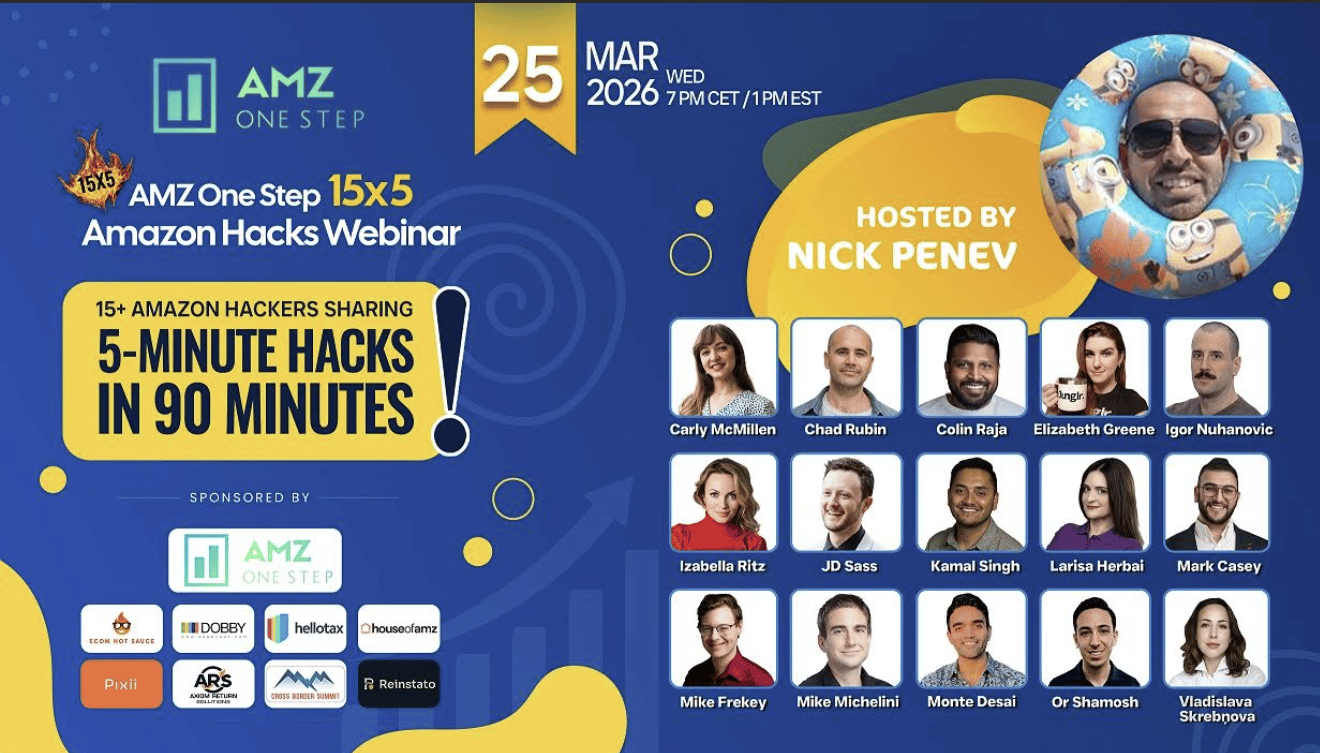
I’m inviting you to the AMZ One Step 15x5 Amazon Hacks Webinar on Wed Mar 25th 7 PM CET/1pm EST
It's an all-out hack-off to see WHO brings the baddest, boldest, brain-melting hacks.
Think: Amazon meets UFC… but with less punching and more profit.
Some of the topics covered: how to generate A+ Content in minutes using AI, why brands should stop waiting for permission to move faster with AI, how AI agents are transforming eCommerce workflows, how top brands are building lasting authority and credibility with AI, and even how entire PPC functions can be rethought and streamlined with AI.
Walmart Just Shoved Its Chatbot Inside ChatGPT. It's Weirder Than It Sounds.
OpenAI's first crack at turning ChatGPT into a shopping cart has, by all measurable accounts, flopped. What replaces it could reshape how every major retailer thinks about AI commerce — and Amazon's response (or spectacular lack thereof) is getting increasingly awkward to watch. Especially for a company that just wrote OpenAI a $50 billion cheque.
The Experiment That Wasn't

Walmart’s Sparky. Source: Walmart
Since November, Walmart has let users buy roughly 200,000 products directly inside ChatGPT through something called Instant Checkout. The pitch was clean: find a product through conversation, buy it without leaving the chat. OpenAI takes a cut. Walmart gets access to high-intent shoppers who are already mid-conversation about what they need.
Conversion rates were three times lower than when users just clicked out to Walmart's actual website.
Three times. Lower.
Walmart's executive vice president Daniel Danker has been admirably candid about why. Instant Checkout forced every item into its own isolated transaction — one product, one order, one shipment. Shoppers took one look at the prospect of receiving five separate boxes for what should have been a single weekly shop and did what any rational human would do: they left.
The whole appeal of a shopping cart is that it's, you know, a cart. Not five individual bags being hurled at your doorstep by five different delivery drivers across five different days. The mental model of "add peanut butter Monday, bin bags Wednesday, panic-buy a birthday present Friday, checkout once" is so deeply embedded in how we shop that breaking it basically broke the entire experience.
Enter Sparky (A Chatbot Inside a Chatbot, Because 2026)
Rather than spend years trying to fix a fundamentally flawed architecture, Walmart and OpenAI have pivoted. Starting this week, Walmart's own AI chatbot — Sparky — now operates directly inside ChatGPT. A similar integration with Google's Gemini is expected next month.
Yes, it's a chatbot embedded inside a chatbot. We've reached the Inception phase of retail AI, and I'm choosing not to examine what that says about where we're headed as a species.
But here's why the nesting doll approach actually matters: users log into Sparky once, and their basket syncs across Walmart's app, website, and whichever AI interface they happen to be using. The Walmart store effectively travels with the customer rather than fragmenting the experience across disconnected touchpoints.
Why the Power Shift Is the Real Story
The strategic significance here extends well beyond a feature update. Under Instant Checkout, OpenAI controlled the transaction layer — it surfaced products, collected payment details, processed orders. Walmart was, in effect, a supplier feeding inventory into someone else's storefront. (Which, for a company that quite literally invented the modern concept of retail dominance, must have been a particularly uncomfortable arrangement.)
Under the Sparky model, Walmart retains control of the entire shopping experience: basket management, cross-selling, bundled recommendations, payment, fulfilment. OpenAI becomes the distribution surface, not the transaction engine.
This distinction matters enormously. When someone asks ChatGPT about setting up a new television, Sparky can recommend the TV, the HDMI cable, the wall mount, and the surge protector as a bundle. That kind of cross-sell logic was impossible under Instant Checkout's one-item-at-a-time architecture. It's the difference between a helpful store associate and a vending machine that only accepts exact change.
Danker has also flagged something worth paying attention to: ChatGPT is now delivering new customers to Walmart at roughly twice the rate of traditional search engines. And these customers don't look like Walmart's typical demographic, suggesting conversational AI is opening retail platforms to audiences that wouldn't ordinarily find them through conventional channels.
The Numbers Are Interesting. The Product Is... Less So.
Sparky is not without its issues. Danker has publicly acknowledged the chatbot can be slow and generates weak responses often enough to risk being dismissed as unreliable. On Reddit, people claiming to be Walmart employees have been, shall we say, forthcoming with their assessments. Positive testimonials remain difficult to locate in the wild.
Yet the usage data is harder to dismiss. Walmart says half its app users have engaged with Sparky, and Sparky users spend approximately 35 percent more per order than non-Sparky shoppers. The behaviour is revealing too: users search the regular Walmart app for staples like milk and bananas, but they turn to Sparky for more complex queries — unfamiliar products, recipe-based shopping, problem-solving across categories.
Among Instant Checkout's top-selling categories, vitamin and protein supplements led the way — driven in part by consumers new to GLP-1 weight-loss medications seeking nutritional guidance through ChatGPT. (AI-assisted supplement shopping prompted by a different class of medication. We're living in the future, and it's extremely specific.) Automotive, beauty, home, hardware, and tools collectively accounted for more than half of orders. These aren't impulse categories. They suggest AI-mediated discovery is currently strongest where consumers need information before they need a product — precisely the kind of purchase journey where a capable shopping agent adds genuine value.
Meanwhile, in Seattle: A $10 Billion Chatbot and a $50 Billion Bet
Which brings us to the question Amazon sellers should be sitting with: where does Rufus go from here?
Because here's the thing — Rufus is not some experimental side project anymore. Amazon estimates the chatbot will generate an additional $10 billion in annualised sales. 250 million shoppers have used it this year, monthly active users are up 140% year over year, and customers who engage with Rufus are 60% more likely to complete a purchase. Internal planning documents reportedly project Rufus contributing over $700 million in operating profit this year, climbing to $1.2 billion by 2027.
That's not a prototype. That's a revenue engine with a chatbot costume on.
And then there's the $50 billion elephant in the room. In February, Amazon unveiled a massive strategic partnership with OpenAI — the same OpenAI that powers the ChatGPT platform where Walmart just deployed Sparky. The deal includes an initial $15 billion commitment with another $35 billion to follow, OpenAI spending $100 billion on AWS over the next eight years, and a commitment to deploy 2 gigawatts of Amazon's Trainium AI chips. The two companies will also jointly develop customised models for Amazon's engineering teams.
So Amazon has simultaneously invested $50 billion in the company behind ChatGPT, built a $10-billion-a-year shopping assistant of its own, and has been actively blocking AI bots from scraping its product data. If that sounds like a company trying to keep every strategic option open while committing fully to none of them — well, welcome to large-cap corporate strategy in 2026.
On Amazon's most recent earnings call, CEO Andy Jassy was asked directly about agentic commerce. His response had that distinctive texture of carefully worded enthusiasm — he compared AI shopping agents to the early days of search engines and confirmed Amazon is "having conversations with and expect, over time, to partner with third-party agents." He then stopped short of announcing anything specific.
Referral traffic from ChatGPT to Amazon reportedly fell nearly 18 percent after the company tightened bot restrictions. Amazon's advertising business generated $56 billion in revenue last year, and that business depends on shoppers browsing Amazon's own surfaces. Every purchase inside ChatGPT is a purchase that doesn't generate an ad impression on Amazon.
It's the retail equivalent of saying "we'd love to have dinner sometime" while actively changing your locks. Though now you've also invested $50 billion in the locksmith.
Could Rufus Follow Sparky's Playbook?
Walmart's Sparky integration establishes a clear template: retailer deploys its own AI agent inside external platforms, maintains control over the shopping experience, accesses new audiences. If that model proves commercially viable — and the early engagement data, despite Sparky's rough edges, suggests it could — Amazon will face growing pressure to do something similar with Rufus.
The OpenAI partnership makes this scenario considerably more plausible than it was a few months ago. Amazon now has a deep commercial relationship with the platform where this kind of integration would happen. The infrastructure pipes are being built. The joint model development is underway. The strategic logic practically writes itself.
Amazon's track record supports the prediction too. The company built its own social commerce product, Inspire, to compete with TikTok. When that didn't gain traction, Amazon quietly discontinued it and partnered with TikTok instead. Build first, partner when necessary — it's practically a corporate philosophy at this point.
For Amazon sellers, the implications are significant. If Rufus eventually operates inside ChatGPT, Gemini, or other conversational interfaces, the dynamics of product discovery change substantially. Sponsored product placements, keyword optimisation, and traditional search-driven advertising would need to coexist with — or adapt to — a model where an AI agent curates, recommends, and potentially bundles products on behalf of the consumer. The sellers who understand how to surface effectively within AI-mediated conversations, not just search result pages, will have a structural advantage. The sellers who wait for Amazon to formally announce a strategy will be doing what sellers always do when they wait for Amazon to formally announce things: reacting six months too late.
The Bottom Line
None of this is happening overnight. Sparky is still too slow and too inconsistent for complex shopping tasks. Third-party agents remain a tiny fraction of referral traffic. Amazon is spending $125 billion on capital expenditure in 2025 alone — a figure expected to rise in 2026 — largely driven by AI infrastructure.
Danker himself cautioned against the more utopian projections: "This idea that it will all become automated might be a little bit far-fetched. People do get excited about shopping for clothes, for their home, for their children."
But the direction of travel is unambiguous. Walmart has made its choice: bring the store to wherever the customer is talking. Amazon has a $10 billion chatbot, a $50 billion partnership with the platform hosting that store, and no public plan for connecting the two. The pieces are all on the board. Someone in Seattle just needs to make the move.
P.S. — A chatbot inside a chatbot. If someone proposes a chatbot inside that chatbot next quarter, I'm taking a sabbatical.
P.P.S. — Walmart says Sparky users spend 35% more per order. So the chatbot that everyone on Reddit thinks is useless is also, apparently, Walmart's most effective upselling tool. The internet remains undefeated at being wrong about retail.
P.P.P.S. — Amazon invested $8 billion in Anthropic, $50 billion in OpenAI, and is spending $125 billion on capex this year. At some point "we're still evaluating our options" stops being caution and starts being a very expensive way of saying "we haven't decided yet."
Do You Love The AI For Ecommerce Sellers Newsletter?
You can help us!
Spread the word to your colleagues or friends who you think would benefit from our weekly insights 🙂 Simply forward this issue.
In addition, we are open to sponsorships. We have more than 66,000 subscribers with 75% of our readers based in the US. To get our rate card and more info, email us at [email protected]
The Quick Read:
New research says ChatGPT pulls most carousel products from Google Shopping, making ecommerce visibility increasingly tied to shopping fan outs.
OpenAI’s GPT 5.4 guide shows better results come from clear output rules, tool instructions and a precise definition of done, not just smarter prompts.
Visa backed agent payments are now live, giving AI assistants spendable cards and raising urgent questions around prompt injection, liability and control.
Walmart’s new Recognized Reviewer option gives Marketplace sellers a compliant way to seed early reviews with free samples and build trust faster.
Consumers still want humans in customer service, with fresh survey data showing low trust in fully AI run support and stronger confidence in people led help.
AI assistants now generate session volume equal to 56% of global search, showing discovery is expanding fast beyond traditional engines, especially on mobile.
Anthropic reportedly scaled much of its marketing with one operator and Claude Code, pointing to a future where automation shrinks whole growth teams into one workflow.
The Tools List:
🌪️ LoudFame - Stylize your video with creative AI filters.
📹 MeetGeek: Automagically record videos, transcribe, summarize, and share insights from every meeting to any tool.
🤖 AI camp - Access multiple LLMs, assistants, and tools, for teams of all sizes.
📻 Listnr - A free voice & video generator with over 900+ voices in 142 languages.
🗣️ Fireflies AI: Automate your meeting notes. Transcribe, summarize, search, and analyze voice conversations.
About The Writer:

Jo Lambadjieva is an entrepreneur and AI expert in the e-commerce industry. She is the founder and CEO of Amazing Wave, an agency specializing in AI-driven solutions for e-commerce businesses. With over 13 years of experience in digital marketing, agency work, and e-commerce, Joanna has established herself as a thought leader in integrating AI technologies for business growth.
For Team and Agency AI training book an intro call here.