- AI for Ecommerce and Amazon Sellers
- Posts
- Walmart's AI Shopping Test Failed Spectacularly
Walmart's AI Shopping Test Failed Spectacularly
(And That's the Point)

Jo Lambadjieva
April 03, 2026
In partnership with


From Our Sponsor:
Turn AI into Your Income Engine
Ready to transform artificial intelligence from a buzzword into your personal revenue generator?
HubSpot’s groundbreaking guide "200+ AI-Powered Income Ideas" is your gateway to financial innovation in the digital age.
Inside you'll discover:
A curated collection of 200+ profitable opportunities spanning content creation, e-commerce, gaming, and emerging digital markets—each vetted for real-world potential
Step-by-step implementation guides designed for beginners, making AI accessible regardless of your technical background
Cutting-edge strategies aligned with current market trends, ensuring your ventures stay ahead of the curve
Download your guide today and unlock a future where artificial intelligence powers your success. Your next income stream is waiting.
Walmart's AI Shopping Test Failed Spectacularly (And That's the Point)
Okay, I need to talk about something that perfectly encapsulates where we are with AI commerce right now. Walmart just ran what might be the most expensive experiment in proving something we all secretly suspected: people will happily let AI help them shop, but the moment it asks for their credit card number, they panic like they've been asked to hand their wallet to a stranger on the subway.
The Discovery Layer That Actually Works
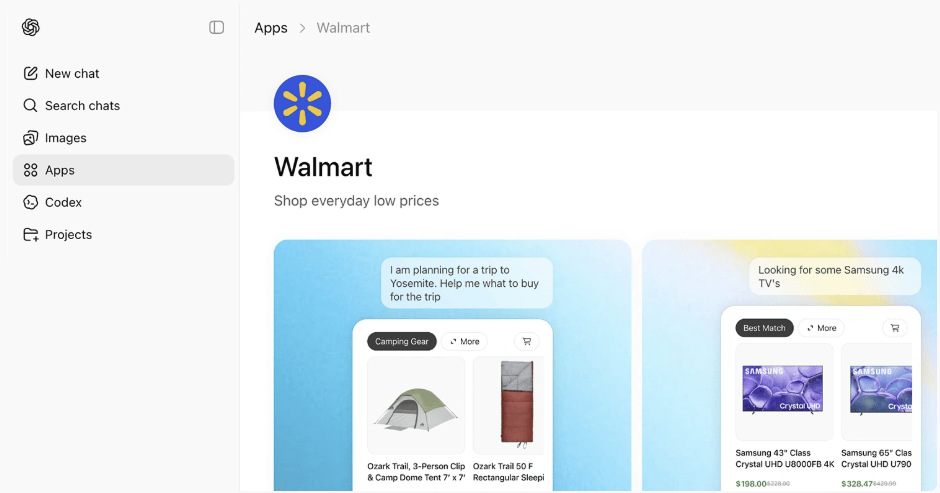
Walmart’s ChatGPT App. Source: GeekSeller
Here's what Walmart built: a dedicated app inside ChatGPT that lets users search products, compare options, and add items to their cart without leaving the chat interface. And by most accounts, the discovery experience is genuinely impressive. You ask for running shoes, it doesn't just dump a search results page on you. It actually talks you through options, suggests alternatives, considers context. Less "here are 4,000 results sorted by Best Seller rank" and more "based on what you've told me, here are three options and why each one might work."
What's particularly interesting for marketplace sellers: Walmart isn't limiting the catalogue to their fulfillment-centre darlings. Seller-fulfilled items show up too, including listings without free shipping. They're basically opening the entire marketplace to the AI, which is either a sign of genuine commitment to the integration or a sign that nobody had time to build the filter. (I'm choosing optimism here, but I've been burned before.)
Run the same query on Walmart.com and through the AI, and the results don't fully overlap. The AI version leans harder into alternatives and related products — it's more exploratory, more "have you considered this?" It feels less like a search engine and more like that one friend who's inexplicably knowledgeable about air fryers and won't let you make a bad purchase.
This is a material shift in how Walmart surfaces products. The traditional Walmart.com experience is a ranked list driven by algorithms sellers have spent years learning to game. The AI experience is a conversation driven by intent. Those are fundamentally different discovery mechanisms, and they reward fundamentally different product content strategies.
The Checkout Catastrophe (66% Worse, To Be Precise)
Here's where the narrative takes a sharp turn into a ditch.
Walmart also tested letting people complete purchases entirely within the AI interface, bypassing Walmart's own checkout flow. You know, the whole "never leave the chat" promise that every AI commerce pitch deck has been breathlessly promoting for the past eighteen months.
The conversion rate was roughly one-third of what Walmart gets when users click through to their actual website. Let me restate that for the people in the back: two out of every three potential sales evaporated because the checkout happened inside a chatbot instead of Walmart.com.
Daniel Danker, Walmart's EVP of product and design, described the in-chat checkout experience as "unsatisfying." Which is corporate-speak for "people hated it," delivered with the kind of diplomatic restraint you develop after years of giving interviews where you can't say what you actually think.
And when you think about it, this makes complete sense. Checkout isn't just a transaction — it's a trust environment. Your saved payment methods are there. Your delivery addresses. Your order history that proves this company has successfully delivered things to you before without stealing your identity. Ripping all of that away and replacing it with a text box is like trying to conduct a mortgage closing in someone's DMs. Technically possible. Emotionally unhinged.
Walmart's Pivot Is the Real Story
Here's the part that matters most, and it's the part getting buried under all the "AI shopping is the future" headlines.
Walmart is already pulling back from third-party checkout. Instead of pushing purchases through someone else's infrastructure, they're planning to embed their own chatbot, Sparky, directly into AI interfaces. Users would log into their Walmart accounts, sync their carts, and complete purchases within Walmart's own system — even while technically inside a different platform. Similar integrations are expected with Google Gemini.
This is Walmart essentially saying: "You can help our customers find things. But the moment money changes hands, they're coming back to us." Which is a profoundly sensible position that also happens to protect the most strategically valuable part of the customer relationship — the bit where you know who they are, what they've bought before, and where they live.
The architectural split that's emerging is clean and logical: the AI layer handles discovery, recommendation, and comparison. Walmart handles identity, payment, and the "please don't lose my package" layer. Each side does what it's structurally built to do, instead of one side pretending it can do everything.
For Walmart specifically, this is a power move disguised as a compromise. They get the benefit of AI-driven product discovery — a potentially massive new traffic source — without ceding control of the transaction. The customer data stays with Walmart. The payment relationship stays with Walmart. The AI gets to be a very helpful shop assistant who isn't allowed anywhere near the till.
What This Means for Walmart Marketplace Sellers
If you're selling on Walmart's marketplace, there are a few things worth paying attention to here.
First, the full catalogue exposure matters. Walmart isn't curating a pristine subset of operationally perfect listings for the AI storefront. Seller-fulfilled items are showing up alongside WFS listings, which means your products have a shot at being surfaced through conversational discovery regardless of your fulfilment method. That's a bigger deal than it sounds, because it suggests Walmart sees AI discovery as an extension of the full marketplace, not a premium tier.
Second, the way the AI surfaces products is different from Walmart.com search. The emphasis is on conversational context, alternatives, and intent matching rather than keyword ranking. This means the product content that wins in an AI-driven discovery environment is content that answers questions — what's this product for, who is it best suited to, how does it compare to alternatives — rather than content stuffed with search terms and backend keywords.
Third, the checkout data should make every seller breathe a small sigh of relief. The 66% conversion drop when checkout happened outside Walmart's environment means the transaction is staying on Walmart's turf for the foreseeable future. Your existing checkout optimisation — pricing, shipping options, reviews, fulfilment speed — still matters enormously. AI isn't replacing the conversion fundamentals. It's adding a new layer on top of them.
And fourth, Sparky is coming. Walmart's own AI chatbot being embedded into third-party platforms means Walmart is building its own conversational commerce capability rather than outsourcing it entirely. How Sparky handles product recommendations, which listings it favours, and what signals it uses to rank options are all questions that will matter increasingly over the next year. If you've been ignoring Walmart's AI initiatives because they felt experimental — well, they just got a lot less experimental.
The Bottom Line
Walmart just handed the industry its clearest real-world evidence for something that's been theoretical until now: AI is becoming a powerful discovery layer, but the point of purchase remains stubbornly anchored to environments the retailer controls.
People will let AI help them decide what to buy. They will not let AI hold their credit card. The gap between where customers find products and where they actually purchase them is widening, and Walmart — to their credit — is building for that reality instead of pretending it doesn't exist.
For marketplace sellers, the practical takeaway is straightforward: your product content now needs to work in two contexts. The structured, keyword-driven Walmart.com search that still governs most transactions, and the conversational, intent-driven AI layer that's increasingly governing how people figure out what to buy in the first place.
The robots are getting remarkably good at the "what should I buy?" question. They're just terrible at the "take my money" part. Walmart seems to have figured that out faster than most.
Do You Want To Learn How To Optimize for AEO?
Good. I literally write the manual in the form of a newsletter weekly here.
Check it out and make sure to subscribe!
The Quick Read:
A 16 month SEO test found AI content on fresh domains can get indexed and briefly rank, but without authority, trust and original insight, visibility fades fast and traffic stalls.
ChatGPT ads are scaling fast, but with weak targeting, manual buying and almost no reporting, advertisers are being asked to spend on a channel that still cannot prove real performance.
Performance marketing in 2026 is becoming more intelligent, more AI driven and far more connected to SEO and AEO, turning measurement into a full funnel game instead of a paid media silo.
AI content is not the SEO villain, thin and spammy content is, and the brands that learn to use AI well will move faster while everyone else debates a battle Google has already moved past.
Google wants switching to Gemini to feel frictionless, with new tools that import memories and full chat history from rival AI apps so users can bring their digital context with them.
Google’s Veo is turning static images into campaign ready video ads, giving marketers a faster way to scale creative, personalise assets and keep performance fresh without a production team.
The Tools List:
👨💼 Aesop - Your AI-powered SaaS to find smart, distinctive names and the stories they tell – for your new brand, business, product, or project
🖊️ Respell - Combine no-code workflows, agent chat, and AI suggestions to automate work.
🖥️ Sheet Copilot - Run tasks in Google Sheets using AI.
🤖 Top GPTs - Access the best OpenAI GPTs without a Plus subscription
🪄 Magic - An optimization tool that upgrades your AI workflow with integrations with Bard, Claude, Midjourney, & more.
🤖 Getverk AI - It allows its users to hire AI-generated employees.
About The Writer:

Jo Lambadjieva is an entrepreneur and AI expert in the e-commerce industry. She is the founder and CEO of Amazing Wave, an agency specializing in AI-driven solutions for e-commerce businesses. With over 13 years of experience in digital marketing, agency work, and e-commerce, Joanna has established herself as a thought leader in integrating AI technologies for business growth.
For Team and Agency AI training book an intro call here.