- AI for Ecommerce and Amazon Sellers
- Posts
- TikTok Live, AI And the Death Of The Sales Funnel
TikTok Live, AI And the Death Of The Sales Funnel
How fake people selling real products broke everything we know about commerce

Jo Lambadjieva
December 10, 2025

From Our Sponsor:
The Year-End Bookkeeping Mistake Multi-Channel Sellers Keep Making
While you're juggling inventory counts and marketplace reports, smart ecommerce sellers are using a simple checklist to close their books clean.
Ecommerce bookkeeping doesn't have to be chaos. But most sellers are doing it completely wrong.
ConnectBooks just released something every seller needs.
Built specifically for multi-channel sellers:
Reconciling marketplace payouts (Amazon, Shopify, Walmart, eBay, TikTok)
Reviewing fees you might have missed
Validating inventory across channels
Organizing expense documentation
Getting profit clarity before year-end
Stop scrambling. Start closing strong.
TikTok Live, AI And the Death Of The Sales Funnel

Let’s Get Sold
Kim Kardashian just did a 45-minute variety show on TikTok with Snoop Dogg and her mom to sell shapewear. Not a commercial. Not an influencer post. A full-on VARIETY SHOW.
And look, I know what you're thinking—another celebrity cash grab. But this is actually signaling something much bigger about where ecommerce is headed.
The Part Where Everything We Know About Sales Funnels Goes Out the Window
Remember when we all had those neat little diagrams showing the customer journey? Awareness → Consideration → Purchase? Yeah, well, TikTok just took that funnel and compressed it into the time it takes to watch a single video of someone applying mascara.
Here's what's genuinely mind-blowing: livestream commerce is hitting 25-30% conversion rates. THIRTY PERCENT. Meanwhile, the rest of us are over here celebrating if our carefully optimized Shopify stores hit 3%.
I watched one of these streams last week (purely for research, definitely not because I got sucked into watching someone organize their Stanley cup collection for 47 minutes). Within that stream, viewers discovered products they'd never heard of, watched them being used in real-time, asked questions that got answered immediately, and bought them without ever leaving the app. The entire customer journey—from "what's that?" to "take my money"—happened faster than it takes me to decide what to have for lunch.
The Scary Part Nobody Wants to Talk About
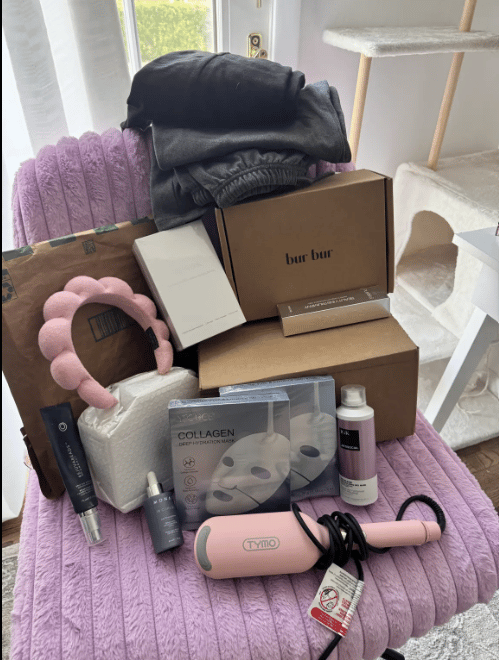
Tiktok shop pile. Source: Samantha Gashi
So there's this woman in Baltimore who spent $3,000 on TikTok Shop in six months. Three. Thousand. Dollars. And she didn't even realize it was happening because—and this is the part that keeps me up at night—she wasn't "shopping." She was just scrolling.
The platform has basically weaponized our lizard brains. You're watching someone's morning routine, they mention their favorite coffee maker, there's a little orange shopping cart icon, and boom—you've bought a $200 espresso machine before your rational brain even shows up to the party.
One financial therapist I talked to (yes, financial therapy is a thing now, because apparently we need therapists for our money problems too) said their clients literally can't distinguish between entertainment and being sold to anymore. And honestly? That's exactly what TikTok wants.
The Part Where TikTok Shows Its Mob Boss Energy
Here's where things get properly dystopian. In September, TikTok updated their guidelines to basically say: "If you try to send traffic to your own website instead of letting people buy through TikTok Shop, we're going to bury your content so deep even archaeologists won't find it."
I'm paraphrasing, but barely.
They're literally punishing brands for trying to maintain their own customer relationships. It's like if your local mall started following you home to make sure you didn't shop anywhere else. Except the mall is an algorithm and home is the entire internet.
For those of us running ecommerce businesses, this creates an absolutely delightful (read: nightmarish) choice: either hand over a chunk of every sale to TikTok and let them own your customer data, or watch your content get algorithmically ghosted. Fun times!
And Now For Something Completely Terrifying: Robot Salespeople

The AI Avatars in China selling millions
Just when you thought it couldn't get weirder, China enters the chat with AI hosts that are pulling in MILLIONS in sales. Not thousands. MILLIONS.
Brother (the printer company, because apparently they're cool now?) used an AI avatar that generated $2,500 in two hours. Baidu created a virtual clone of an influencer that ran for SIX HOURS STRAIGHT, got 13 million views, and sold $7.6 million worth of stuff.
Let me repeat that: A FAKE PERSON SOLD SEVEN POINT SIX MILLION DOLLARS OF PRODUCTS.
These aren't your garden-variety chatbots that make you want to throw your phone across the room. These are sophisticated AI avatars that can read comments, adjust their pitch based on audience reaction, and—here's the kicker—never need a bathroom break, never get tired, and never accidentally say something controversial after their third glass of wine.
The technology is evolving so fast that by the time you finish reading this newsletter, there's probably a new AI influencer selling vitamin supplements to your mom.
The Authenticity Paradox (Or: Why This Makes My Brain Hurt)
Here's the philosophical pretzel that's been keeping me up: Live commerce works because it feels authentic. You're watching a real person use real products in real-time. It's the digital equivalent of that friend who always has the best recommendations.
But now we're replacing those real people with AI avatars that are basically very sophisticated lying machines. They're demonstrating products they've never used (because they don't have hands), sharing experiences they've never had (because they don't exist), and building trust through a performance of authenticity that's entirely manufactured.
And the really twisted part? It's working. People are buying from these AI hosts. In massive numbers.
Part of me wants to be outraged about this. The other part of me is genuinely impressed by the audacity. It's like we've collectively decided that reality is optional as long as the shipping is free.
What This Actually Means for Anyone Trying to Sell Things Online
Look, I've been in ecommerce long enough to know that every few years someone declares the end of the world as we know it. Usually, it's just another way to sell consulting services (and yes, I see the irony here).
But this feels different. This isn't just a new marketing channel or a platform update. It's a fundamental restructuring of how products move from "exists in a warehouse" to "arrives at your door."
If you're running an ecommerce business, here's what you need to be thinking about:
Just Start Going Live Already: I know, I know—the thought of talking to your phone for an hour while people watch makes you want to crawl under your desk. But here's the thing: TikTok Live is converting at rates that make your best Facebook campaigns look like they're not even trying. You don't need Kardashian-level production. You need a ring light, a personality (or at least caffeine), and products to talk about. The brands testing this now—even the awkward ones fumbling through their first streams—are capturing data and customer relationships that will compound. Start messy. Start nervous. Just start.
The Platform Dependency Trap: TikTok is basically saying "nice business you've got there, would be a shame if something happened to your reach." You need to decide if you're comfortable with that level of dependence or if you want to maintain some independence (and potentially sacrifice growth).
The AI Decision: Do you jump on the virtual host bandwagon now while it's still weird and potentially get ahead of the curve? Or do you wait until the technology gets less creepy and risk being late to the party? There's no right answer, which is incredibly unhelpful, I know.
The Authenticity Question: How do you maintain genuine connections with customers when the entire ecosystem is pushing toward manufactured experiences? This might be the most important question of all, and I definitely don't have a good answer.
The Bottom Line (Because This Newsletter Is Already Too Long)
We're watching the birth of something genuinely new in commerce. Not just a new way to advertise or a new platform to master, but a complete reimagining of what shopping even means.
The part of me that loves chaos and innovation is fascinated. The part of me that remembers when the internet was supposed to democratize commerce is concerned. And the part of me that runs an actual business is frantically taking notes while having a minor panic attack.
TikTok isn't just changing how we sell products. They're changing what selling products means. And whether we like it or not (spoiler: I'm genuinely not sure if I like it or not), we're all going to have to figure out how to exist in this brave new world where shopping is entertainment, entertainment is shopping, and the salesperson might not even be real.
The infrastructure for this new reality is being built right now, while we're all still trying to figure out if Threads is worth posting on. The question isn't whether this becomes the future of commerce—that train has already left the station, and Kim Kardashian is conducting it while Snoop Dogg provides commentary.
The question is whether we're going to help shape this future or just wake up one day to find our businesses have been algorithmically optimized out of existence.
P.S. - I just checked and there are already 47 new AI influencer platforms that launched while I was writing this. I'm only slightly exaggerating.
P.P.S. - If you're reading this and thinking "maybe I should create an AI version of myself to run my business," please remember that the flesh-and-blood version of you is probably weird enough. We don't need two of any of us.
P.P.P.S. - But seriously, if you figure out how to make an AI avatar that can handle my email inbox, please let me know. I'll pay good money for that kind of witchcraft.
Do You Love The AI For Ecommerce Sellers Newsletter?
You can help us!
Spread the word to your colleagues or friends who you think would benefit from our weekly insights 🙂 Simply forward this issue.
In addition, we are open to sponsorships. We have more than 59,000 subscribers with 75% of our readers based in the US. To get our rate card and more info, email us at [email protected]
The Quick Read:
Amazon is testing AR glasses that guide drivers hands free with scanning, routing and delivery proof, hinting at a wearable AI future for last mile logistics.
AI safety rules barely slow US progress while the real China risk lies in chip exports and application layer dominance, not alignment policy.
Black Friday hit records as AI shopping surged, with AI referred buyers converting 38 percent higher and starting their journey with a prompt instead of a homepage.
Gemini 3 in Figma auto generates layouts, components and code ready prototypes, speeding UI creation without replacing design judgment.
Holiday spend is racing toward 253 billion dollars as mobile passes 50 percent and AI driven traffic jumps 758 percent, reshaping how shoppers find deals.
OpenAI may stay unprofitable through 2030 and still need more than 200 billion dollars in compute as infrastructure costs outpace revenue growth.
B2B marketing now needs new metrics like LLM share of voice, influence and deal velocity as AI reshapes demand and revenue creation.
Runway Gen 4.5 boosts motion quality, control and consistency at Gen 4 speed, setting a new standard for accessible pro grade AI video.
Smarter prompts replace “write my email” by turning ChatGPT into an editor or cold outreach engine for cleaner tone and higher impact.
Anthropic is exploring a 300 billion dollar valuation and a possible IPO while scaling infrastructure to compete with OpenAI.
Anthropic chief scientist Jared Kaplan says humanity must decide by 2030 whether to allow AI to self train, risking either a breakthrough or loss of control.
The Tools List:
📝 Copy AI - Generate content, such as blog headlines, emails, and social media posts using AI (link)
🎯 Dart - A tool to manage tasks and workflows using AI assistance.
🤗 Dorik AI - Generate beautiful websites from a single prompt.
🤖 Envato - Create better AI images with beautiful, free and endlessly reusable style prompts for Midjourney, Clipdrop, Firefly and DALL-E
🖋️ Jacquard: AI tool for enterprise marketers, optimising content across digital channels with performance prediction and brand controls.
📹 Studio Neiro AI - Scale your marketing videos with AI avatars.
About The Writer:

Jo Lambadjieva is an entrepreneur and AI expert in the e-commerce industry. She is the founder and CEO of Amazing Wave, an agency specializing in AI-driven solutions for e-commerce businesses. With over 13 years of experience in digital marketing, agency work, and e-commerce, Joanna has established herself as a thought leader in integrating AI technologies for business growth.
For Team and Agency AI training book an intro call here.