- AI for Ecommerce and Amazon Sellers
- Posts
- The Human Moat In the Age of AI
The Human Moat In the Age of AI
An upskilling strategy you should read

Jo Lambadjieva
January 30, 2026

From Our Sponsor:
Nano Banana Pro for Amazon Sellers (The Ultimate Guide)

This Nano Banana Pro guide is getting passed around the Amazon seller community like the town bicycle:
Google’s Nano Banana Pro AI is the first AI that big sellers and aggregators are using to generate high converting listing images for their top selling products.
..and this guide (written by our friend Chris Rawlings) shows you exactly how to use Nano Banana Pro to generate all your listing images (even the graphic design ones) with no graphic designer, no photographer, in minutes.
The Human Moat: Why Your Career Insurance Policy Just Got Extremely Complicated

Okay, confession time: I've spent the last month obsessively reading research papers about AI and workplace automation instead of doing literally anything productive. My browser history looks like someone preparing for either a TED talk or a complete psychological collapse. My partner asked if I was okay. I showed them a chart about skill commoditization. They stopped asking.
Here's the thing nobody in the "AI will take all our jobs" versus "AI is just a fancy autocomplete" debate wants to admit: they're both wrong. The real picture is messier, more interesting, and honestly kind of fascinating once you stop panic-spiraling long enough to look at the data.
The Great Skill Collapse (And Why It's Not What LinkedIn Thinks)
Remember when knowing how to run a Facebook ad campaign was a marketable skill? When "I can build a Shopify store" was something you'd put on a LinkedIn profile without feeling existential dread? Those were simpler times. Those were last year.
Here's what's happening: the tools that used to require specialized expertise are now accessible to anyone willing to watch a YouTube tutorial and consume dangerous amounts of caffeine. A marketer can spin up A/B tests. An ops manager can build automation workflows. Your intern can generate product photography that would have cost thousands two years ago. (Your intern is terrifying, by the way. Have you seen what they can do with vibe coding?)
This isn't AI making everyone equally capable. It's AI lowering the execution barrier while raising the bar for judgment. The question is no longer "Can you run a campaign?" but "Do you know which campaign to run, for whom, and why?"
That second question is much harder, and no amount of prompt engineering saves you if you don't have a clue.
What AI Actually Makes Worthless (Sorry)
There's a fascinating NBER study on customer support agents using AI assistance. Lower-skilled workers saw productivity increases of 35 percent. The AI packaged communication patterns of top performers and distributed them to newbies. Two months of experience performed like six months when AI-assisted.
Sounds great, right? Here's the twist: highly skilled workers saw minimal gains and sometimes decreased performance quality using the same tools.
The AI couldn't improve on expertise already superior to the average patterns encoded in the model. It's like giving a Michelin-star chef a meal kit subscription. ("Here's how to dice an onion, Chef. You're welcome.")
This reveals AI's fundamental limitation. It excels at explicit knowledge—documented processes, established patterns, codified best practices from countless blog posts and $997 courses. It struggles with tacit knowledge: pattern recognition from edge cases, intuition about when conventional approaches won't work, judgment calls depending on context that can't be Googled.
AI can generate product descriptions, suggest bid strategies, analyze performance data. It cannot sense when a market is shifting, recognize a customer segment needs a different approach, or understand platform policy implications before Twitter starts freaking out.
(By the time it's on Twitter, you're already too late. That's basically the rule now.)
The Skills That Actually Matter Now (Finally, Something Useful)
If explicit knowledge is commoditized, what remains valuable? Not a single capability, but combinations that create what researchers call "tacit judgment and embodied expertise." Think of these as skill combos—like in Mortal Kombat, except the fatality is your competitor's market share and also maybe your own sanity.
Creativity and Taste
AI can generate thousands of variations on a product page or ad creative. What it cannot do is determine which approach will resonate with a specific audience in a specific moment, or recognize when all the technically correct options still miss the mark entirely.
This is why AI-generated content increasingly looks identical. Every vibe-coded website features the same rounded corners and gradient color schemes. Every AI-written product description follows the same formulaic structure. You know the one: "Introducing [Product]. The [adjective] solution for [target audience] who want [benefit]."
I see these in my sleep now. They haunt me. Please make it stop.
The difference between technically correct and genuinely compelling determines whether customers merely understand your product or actually want to buy it. And that difference? It's not something you can prompt your way into. I know because I've tried. At 3 AM. Multiple times.
Critical Thinking
AI excels at pattern matching but struggles with context-dependent judgment. Models create "cookie cutters" from existing data, which works great until context changes in ways the training data didn't anticipate.
When Amazon changes its algorithm, when a new competitor enters your category, when customer behavior shifts in ways that don't show up in historical data—these situations require questioning assumptions and recognizing when established patterns no longer apply.
With implementation barriers lowered, the constraint shifts from "Can we build this?" to "Should we build this?" and "What happens when we do?" That second question is where most projects die slow, expensive deaths.
Cross-Domain Knowledge
Understanding how the pieces fit together matters more than ever. You don't need to be an expert in everything, but you should know enough about marketplace dynamics, customer psychology, supply chain constraints, and platform mechanics to make sound decisions across domains.
This is why "I'm just a marketing person, I don't do technical" is increasingly a career-limiting statement. (Sorry. I don't make the rules. I just report on them while mildly panicking.)
The Centaur Versus The Cyborg (Yes, Really)
Research from Harvard Business School identified two patterns among high-performing knowledge workers collaborating with AI.
The "Centaur" creates clear division of labor—AI for research, human for interpretation, AI for execution. Tag-teaming with a robot who doesn't need bathroom breaks or emotional validation.
The "Cyborg" intertwines their work with AI at a granular level, working iteratively—starting an analysis, correcting AI's interpretation, continuously adjusting. Messier, but often better results. (Also more exhausting. Nobody talks about this.)
The critical factor in both: deep domain expertise to verify the machine's output. A generalist using AI to optimize Amazon listings might not spot keyword cannibalization issues. A specialist catches these immediately.
This is the "jagged frontier" of AI capabilities—superhuman at some tasks, failing at seemingly simpler ones. You need to know things to know when the AI is wrong. Deeply annoying for everyone hoping to skip the "actually learning stuff" part. I don't have good news for you.
The Cognitive Atrophy Problem Nobody Talks About
Here's a fun risk nobody mentions: as we rely more on AI to perform cognitive work, we may bypass the mechanisms that build tacit knowledge in the first place.
Research shows that "productive struggle"—working through problems, making mistakes, correcting course—is essential for deep learning. When AI provides immediate answers, this struggle is eliminated.
Aviation research consistently shows increased automation leads to skill decay. When systems fail, pilots who've spent years monitoring rather than flying often cannot intervene effectively.
An ecommerce professional who spends years approving AI-generated strategies rather than developing them may gradually lose the ability to create strategy from first principles. When the tools fail—and they will—that professional may find themselves staring at a spreadsheet with no idea what to do next.
The paradox gets worse: as more professionals rely on AI, less human-generated expertise gets encoded into training data. We might be eating our own seed corn. Fun times! (This is what I think about at 2 AM. My therapist says I need healthier hobbies. She's right.)
Building the Actual Moat (The Practical Bit)
Okay, enough doom-spiral. Here's what you actually do about all this. The practical implications come into focus when you understand these skills not as isolated capabilities but as an interconnected system. The power comes from the combinations, not the individual pieces.
Target "wicked" domains for deep expertise. Focus on areas where feedback is delayed, data is messy, and rules are unclear. These are precisely the spaces where AI struggles to automate effectively and where human judgment compounds in value. Avoid building your moat in areas where AI already excels at codified tasks. (If your entire value proposition is "I can do the thing the robot does," I have some uncomfortable news about your five-year plan.)
Embrace productive struggle. Don't bypass the fundamentals. Use AI as an amplifier of expertise you've already built, not as a substitute for building it. If you've never learned to analyze marketplace competitive dynamics manually, you'll never develop the judgment to know when AI's competitive analysis is incomplete or misleading. Yes, this is annoying. Yes, it takes time. No, there is no shortcut.
Document your invisible knowledge. Start capturing the patterns you recognize that others miss, the context clues that guide your decisions, the relationship dynamics you navigate that aren't in textbooks. This tacit knowledge is your competitive advantage—and it becomes more valuable as original human insight becomes rarer. Think of it as writing your own training data, except you're training future-you and anyone who might want to hire future-you.
Build proof consistently. As platforms democratize execution, reputation and demonstrated results become more valuable. The ability to show you've navigated multiple market cycles and platform changes becomes the signal separating you from those with the same AI tools but without judgment to deploy them. Results are the new resume. (Actually, results were always the resume. The actual resume was always kind of a participation trophy.)
The Bottom Line for Anyone Selling Things Online
The gap isn't between those who use AI and those who don't. It's between those building durable expertise and those competing on capabilities AI has already commoditized.
The commerce professional who thrives won't be the one with the most AI tools. It will be the one who built deep, defensible expertise while learning to leverage AI across the full stack.
The age of AI doesn't demand choosing between depth and breadth. It demands using AI to achieve breadth so you can reserve your human cognition for the infinite depth of things that cannot be written down, cannot be easily measured, and cannot yet be automated.
That synthesis—deep tacit knowledge combined with AI-augmented execution—is the human moat that matters now.
And honestly? It's more interesting than just becoming really good at prompt engineering.
(Though that helps too. I'm not going to lie. Learn to prompt. Just don't make it your whole personality.)
P.S. - If you read this entire thing and your takeaway is "so I should definitely learn more AI tools," you've missed the point. Go back and read it again. I'll wait.
P.P.S. - If your takeaway is "I should probably understand my industry deeply before outsourcing my thinking to robots," congratulations. You're ahead of 90% of LinkedIn influencers. The bar is low. Step over it.
Do You Love The AI For Ecommerce Sellers Newsletter?
You can help us!
Spread the word to your colleagues or friends who you think would benefit from our weekly insights 🙂 Simply forward this issue.
In addition, we are open to sponsorships. We have more than 62,000 subscribers with 75% of our readers based in the US. To get our rate card and more info, email us at [email protected]
The Quick Read:
OpenAI is rolling out age prediction on ChatGPT to protect minors as adult content and ads arrive. Under-18 accounts get safeguards, while misclassified users can verify via selfie as OpenAI scales revenue past $20B.
SEO traffic and pipeline have decoupled. AI eats the click, not demand. The winners now optimize for authority, brand clarity, and influence inside AI answers rather than chasing pageviews.
Manus launched one-click app publishing. Build in Manus, publish to TestFlight or Google Play instantly, no Xcode, no Android Studio, no certificate pain.
Mobile apps beat games in consumer spend for the first time in 2025, driven by AI. Generative AI apps tripled revenue, with ChatGPT alone hitting $3.4B and usage exploding on mobile.
It’s here, the fake e-girl era begins!
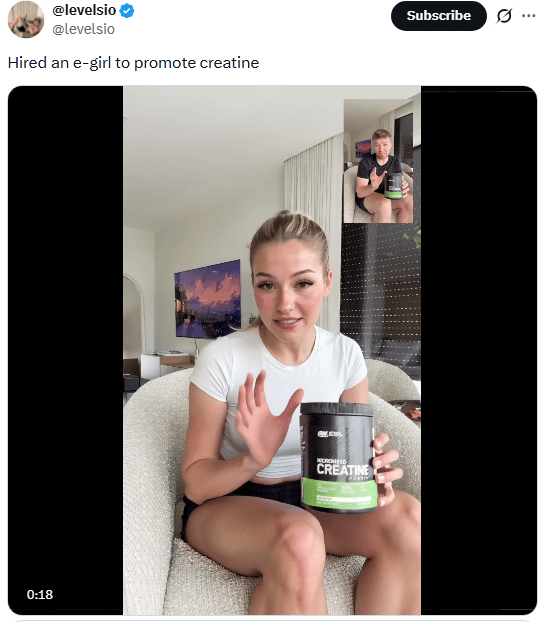
Five SEO experts break down GEO for AI search. Longer prompts, sales calls over keyword tools, YouTube mentions, and clear positioning now matter more than classic ranking tactics.
Arcads hit $10M ARR in under a year by letting brands create AI influencers and UGC-style videos at scale. One image and script can generate thousands of ad-ready videos.
Gemini’s Veo 3.1 adds vertical video, better character consistency, and stronger results with shorter prompts. It’s built for social-first, mobile-native video creation.
The Tools List:
🖊️ SmartWriter: AI-powered tool for personalised email marketing, automating outreach with mass customisation and high engagement rates.
🤖 Captiwiz - Create videos with AI-powered captions.
🖼️ Glif - Remix any image on the web.
📝 Fixkey - Improve your writing everywhere on macOS
📹 Rizzle AI - An AI-driven video creation platform.
⚙️ Agora - The search engine for e-commerce products.
About The Writer:

Jo Lambadjieva is an entrepreneur and AI expert in the e-commerce industry. She is the founder and CEO of Amazing Wave, an agency specializing in AI-driven solutions for e-commerce businesses. With over 13 years of experience in digital marketing, agency work, and e-commerce, Joanna has established herself as a thought leader in integrating AI technologies for business growth.
For Team and Agency AI training book an intro call here.