- AI for Ecommerce and Amazon Sellers
- Posts
- Shopify Just Made Every Store on Earth Shoppable by AI.
Shopify Just Made Every Store on Earth Shoppable by AI.
Yes, Even Yours.

Jo Lambadjieva
April 08, 2026
In partnership with


From Our Sponsor:
Stop babysitting dashboards. Ship from Slack. Touch grass.
700+ teams have Viktor reading their Google Ads every morning.
Your media team opens Slack at 8am. There's a cross-platform brief in #growth: Google Ads spend vs. ROAS, Meta CPA by campaign, Stripe revenue by channel. Viktor posted it at 6am. Nobody asked for it.
Last week, one team's Viktor caught a spend spike at 2am on a broad match campaign and flagged it in Slack: "CPA up 340%. Recommend pausing and shifting budget to the top two performers." That would have burned $3K by morning. The media buyer woke up to a problem already handled.
Your strategist reviews spend trends. Your account manager checks revenue attribution. Same Slack channel, same colleague, before anyone's first coffee.
Google Ads, Meta, Stripe. One message. No Looker, no Data Studio. Anomaly detection runs around the clock. Cross-platform reporting runs on autopilot.
5,700+ teams. SOC 2 certified. Your data never trains models.
"Viktor is now an integral team member, and after weeks of use we still feel we haven't uncovered the full potential." — Patrick O'Doherty, Director, Yarra Web
Shopify Just Made Every Store on Earth Shoppable by AI. Yes, Even Yours.
Source: Shopify
Shopify dropped a bunch of announcements last week. Individually, they look like product updates. The kind of thing you skim in a changelog and forget about by lunch. But if you line them all up and squint, what you're actually looking at is Shopify positioning itself as the connective tissue between every merchant on earth and every AI surface where people are starting to discover products.
This is not a "Shopify launches new feature" story. This is a "Shopify is trying to become the DNS of commerce" story. And it's working.
Your Store Is Now Inside ChatGPT (Whether You Asked or Not)
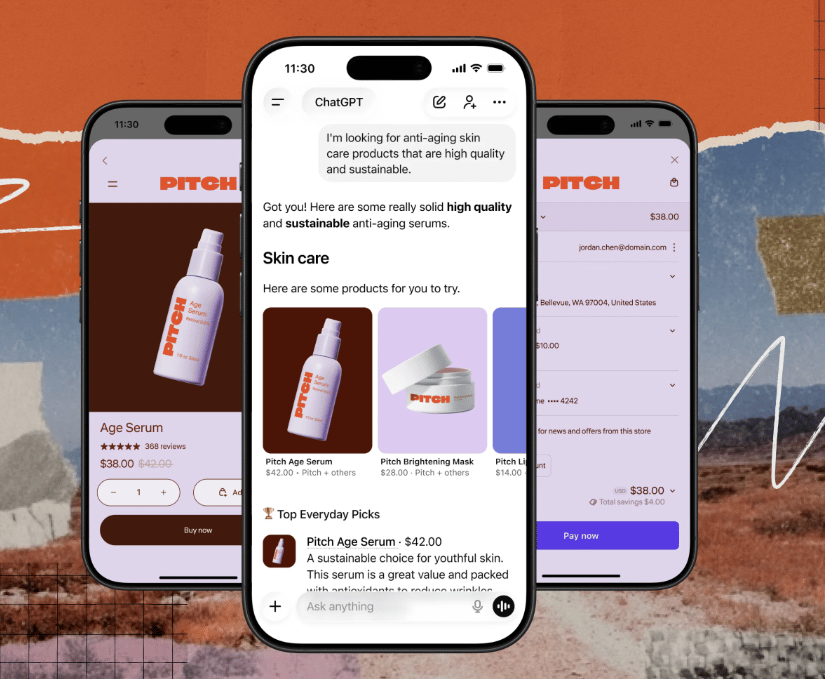
Here's the headline: millions of Shopify merchants are now shoppable inside ChatGPT through something called Agentic Storefronts. Products get automatically syndicated through Shopify Catalog—no additional setup, no separate integrations, no extra transaction fees beyond what you're already paying.
But here's the part that matters: when a shopper actually decides to buy, the purchase happens on your storefront via an in-app browser. Not inside the AI interface. Your brand experience, your pricing logic, your checkout customisations—all intact. The AI handles discovery, you handle everything else.
And ChatGPT is just one surface. These same Agentic Storefronts connect merchants simultaneously to Microsoft Copilot, AI Mode in Google Search, and the Gemini app. All managed from your Shopify Admin. One integration point. Multiple AI surfaces. No frankenstack of separate apps and per-channel engineering headaches.
If that sounds like Shopify just quietly solved a problem that would take most brands six months and a small engineering team to address... yeah, that's basically what happened.
The Move That Changes Everything (And I Mean Everything)
Now here's where it gets genuinely interesting. Shopify launched something called the Agentic plan—now publicly available globally—that lets brands who aren't even using Shopify for their ecommerce add their products to Shopify Catalog and sell across all the same AI channels.
Read that again. You don't need to migrate your store. You don't need to change your tech stack. You just feed your product data into Shopify's system and suddenly your products are discoverable across ChatGPT, Copilot, Google AI Mode, and Gemini.
When I covered this at its announcement in January, the take was that Shopify isn't becoming a marketplace—it's turning the entire internet into its marketplace. Several months later, that assessment has only gotten stronger. Shopify is essentially saying "we don't care where you built your store, we'll make your products findable by AI." Which is either incredibly generous or incredibly strategic (spoiler: it's the second one).
Why OpenAI Gave Up on Checkout (And Shopify Didn't Have To)
Here's a fun bit of recent history. OpenAI spent most of last year trying to own the entire transaction layer inside ChatGPT. They launched Instant Checkout with Stripe. They processed payments directly within the chat window. It was ambitious, elegant, and—by most accounts—a disaster.
Walmart reported that purchases completed inside ChatGPT converted at roughly a third the rate of those redirected to its own website. A third. Turns out that stripping away saved payment methods, delivery preferences, and years of accumulated trust infrastructure doesn't exactly inspire people to hand over their credit card details to a chatbot. (Who could have possibly predicted this? Everyone. Everyone predicted this.)
This week, OpenAI formally backed down. They announced a redesigned shopping experience focused on product discovery—visual browsing, side-by-side comparisons, conversational refinement—while conceding checkout to merchants. In what might be the most diplomatically worded surrender in tech history, they said they're "allowing merchants to use their own checkout experiences while we focus our efforts on product discovery."
Allowing. As if merchants were waiting for permission to use their own checkout. Bold phrasing, OpenAI.
Shopify's model was built for exactly this division of labour from day one. Discovery happens in the AI interface. When a shopper is ready to buy, the merchant's storefront loads in an in-app browser. Customer relationships and data stay with the seller. Orders flow into Shopify admin with ChatGPT referral attribution.
The Master Product Graph (AKA: Shopify's Real Power Play)
Here's the thing about the Agentic plan that deserves more attention than it's getting. If it works at scale, Shopify becomes the host of what you might call the internet's master product graph: a structured, real-time, comprehensive index of what's available to buy, formatted specifically for AI consumption.
Every merchant that feeds data into Catalog strengthens the network. Every AI surface that pulls from Catalog becomes more dependent on it. The flywheel is self-reinforcing, and it's the kind of structural advantage that's very difficult to replicate once it reaches critical mass.
This is a fundamentally different strategic bet from what Amazon, Google, or OpenAI are building. Amazon controls its own catalogue within its own ecosystem (and guards it like a dragon sitting on a very well-organised hoard). Google is building the protocol layer through UCP but doesn't own the fulfilment and payments infrastructure behind it. OpenAI is building a discovery layer that relies on third parties for both product data and checkout. Shopify is offering to be the single source of truth connecting merchants to all of these surfaces—a neutral infrastructure layer with no competing marketplace of its own.
It's the Switzerland of commerce data. Except Switzerland doesn't usually get to clip the ticket on every transaction.
The Amazon-Shaped Hole in the Room
The list of retailers already integrated with OpenAI's Agentic Commerce Protocol includes Target, Sephora, Nordstrom, Lowe's, Best Buy, The Home Depot, and Wayfair. Walmart has gone even further, launching a dedicated app experience inside ChatGPT with account linking, loyalty integration, and its own payments infrastructure.
And Amazon? Conspicuously absent from all of it.
Amazon has historically restricted AI platforms from crawling its product data, choosing instead to develop Rufus—its own AI shopping agent—within its walled garden. The strategic divergence between Walmart's open embrace of AI commerce channels and Amazon's closed approach is getting harder to ignore with every passing announcement.
For Amazon sellers, this creates an asymmetry that's worth thinking about carefully. If product discovery continues migrating toward AI surfaces—and the combined investment from OpenAI, Google, Microsoft, and Shopify suggests the capital is flowing in exactly that direction—then sellers locked exclusively into Amazon's ecosystem may find their products invisible in the environments where a growing share of purchase intent is forming.
The products most likely to be surfaced by AI agents are the ones with the most complete, structured, accessible data. Right now, that data lives in Shopify Catalog, not in Amazon's restricted index. That's not a fatal problem today. But "not a fatal problem today" has a funny way of becoming one.
The Advertising Question Nobody's Asking (Yet)
There's one more dimension here that hasn't gotten enough attention: the relationship between AI discovery and advertising.
OpenAI currently describes its shopping results as organic and unsponsored. But the company has publicly stated its ambition to grow its advertising business tenfold, and product discovery is the capability most naturally suited to ad monetisation. The gap between "organic discovery" and "paid placement" is unlikely to stay as clean as the current marketing materials suggest. (If you've been in digital marketing for more than fifteen minutes, you already know how this story ends.)
Shopify's position in this emerging ad ecosystem is strategically fascinating. If Shopify Catalog becomes the primary source of product data for AI shopping surfaces, and those surfaces start introducing sponsored recommendations and priority surfacing, then Shopify sits at the intersection of the merchant's product data and the AI platform's monetisation layer. Whether Shopify builds its own advertising tools on top of this infrastructure, or simply provides the data pipes that others monetise, is one of the more consequential decisions the company will face in the next year or so.
The Bottom Line for Sellers
If you're on Shopify, your products are already discoverable across multiple AI surfaces. The priority isn't integration work—that's handled. The priority is data quality. Your product titles, descriptions, attributes, imagery, pricing, and inventory need to be structured, complete, and accurate. The AI is doing the selecting now, and it's selecting from the data you provide. Garbage in, invisible out.
If you're not on Shopify, the Agentic plan creates a new decision point. You can add your catalogue to Shopify's system and gain AI distribution without migrating your ecommerce platform. The trade-off—routing your product data through Shopify's infrastructure—is one each brand will need to weigh against how quickly they believe AI-mediated discovery becomes a material channel.
If you're primarily an Amazon seller, the calculation is harder. Amazon's absence from these integrations doesn't mean it's irrelevant—Amazon remains the dominant transaction platform in ecommerce. But a growing discovery layer is forming outside Amazon's walls, and sellers who operate exclusively within them may find themselves invisible to an increasing share of high-intent shoppers who are asking AI what to buy instead of searching Amazon directly.
The sellers who'll be best positioned over the next twelve months aren't the ones waiting to see which AI surface wins. They're the ones ensuring their product data is ready for all of them. And right now, Shopify is making that easier than anyone else—which is either a tremendous public service or the most elegant lock-in strategy in the history of ecommerce. Probably both.
Do You Love The AI For Ecommerce Sellers Newsletter?
You can help us!
Spread the word to your colleagues or friends who you think would benefit from our weekly insights 🙂 Simply forward this issue.
In addition, we are open to sponsorships. We have more than 66,000 subscribers with 75% of our readers based in the US. To get our rate card and more info, email us at [email protected]
The Quick Read:
Bots now outpace humans online, with AI agent traffic exploding so fast that the internet is shifting from human-first browsing to machine-driven activity, making trust, verification and bot governance the next big fight.
Reddit is sharpening its shopping play with richer product ads, community driven deal signals and a Shopify integration, turning high intent conversations into a more direct path to purchase.
Reddit’s new bot crackdown gives authentic brand accounts a clear edge, as app labels, human checks and easier reporting make shady automation far easier to spot and far harder to hide.
The next AI leap is not better chat, it’s systems that define intent, log everything, fix themselves and turn expert know-how into shared infrastructure that compounds faster than humans can keep up.
Google’s rankings and AI answers are shaped by click quality, not just clicks, meaning the brands that win are the ones that earn the click, keep attention and fully satisfy the search.
The Tools List:
🖼️ Tila - Infinite AI canvas. Top neural networks in a single hub
📹 Video interviews by Outset - Conduct user surveys with video and AI.
🖊️ Instant Summaries by Shortwave - Smart TL;DRs for every email.
📧 My Ask AI - Let AI answer 75% of customer support emails.
🤖 Zocket - AI social media ad platform
About The Writer:

Jo Lambadjieva is an entrepreneur and AI expert in the e-commerce industry. She is the founder and CEO of Amazing Wave, an agency specializing in AI-driven solutions for e-commerce businesses. With over 13 years of experience in digital marketing, agency work, and e-commerce, Joanna has established herself as a thought leader in integrating AI technologies for business growth.
For Team and Agency AI training book an intro call here.