- AI for Ecommerce and Amazon Sellers
- Posts
- My 2026 Predictions
My 2026 Predictions
Jo's musings on the future

Jo Lambadjieva
January 02, 2026
In partnership with


From Our Sponsor:
Easy setup, easy money

Making money from your content shouldn’t be complicated. With Google AdSense, it isn’t.
Automatic ad placement and optimization ensure the highest-paying, most relevant ads appear on your site. And it literally takes just seconds to set up.
That’s why WikiHow, the world’s most popular how-to site, keeps it simple with Google AdSense: “All you do is drop a little code on your website and Google AdSense immediately starts working.”
The TL;DR? You focus on creating. Google AdSense handles the rest.
Start earning the easy way with AdSense.
My 2026 Predictions
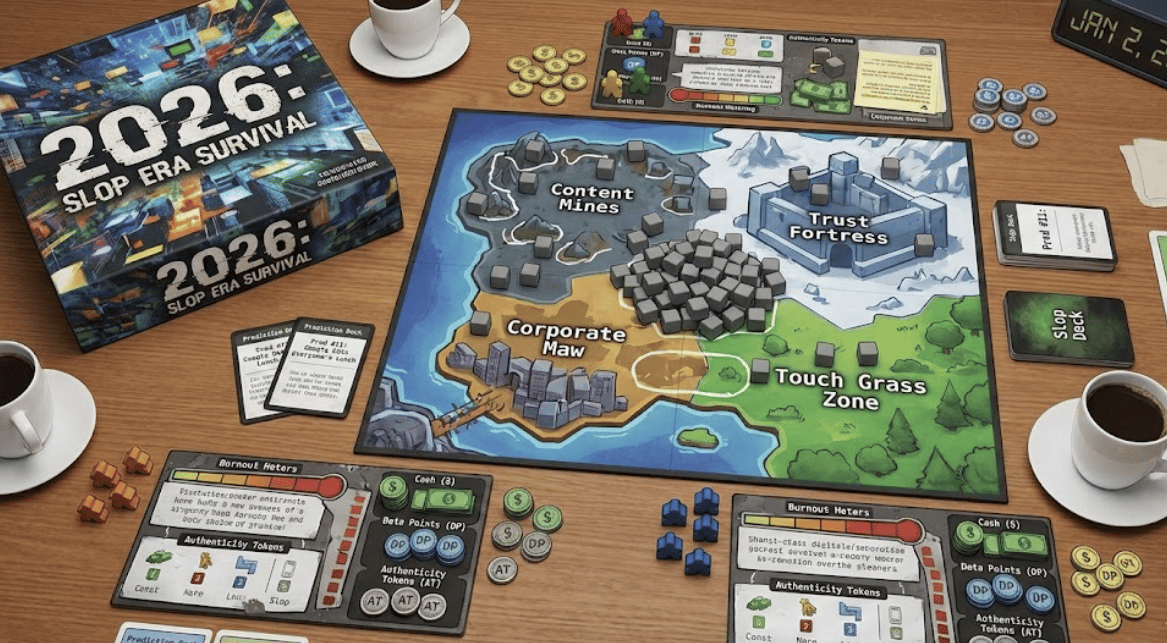
If my predictions were a board game…
Happy New Year! Okay, it's January 2nd, 2026, and instead of nursing a hangover like a normal person, I'm sitting here with my fourth coffee (yes, I know, my sleep schedule is absolutely cooked), ready to drop my predictions for this year. And honestly? The patterns are starting to look genuinely wild.
1. Human-Made Content Becomes the New Luxury Good
Here's something that sounds completely backwards but hear me out: we're about to start paying premium prices for content that's certifiably human-made. Like, actually paying money for the privilege of reading something that came from a real person's brain instead of a machine.
I've been watching this play out in real-time. Publishers are getting absolutely demolished by AI companies scraping their content, training on it, then serving it back without attribution or compensation. It's like watching someone photocopy your homework, get an A, and then charge you for tutoring. The audacity is genuinely impressive.
The smart creators? They're already building paywalls so high you'd need a ladder and a sherpa to climb them. And here's the kicker—people are actually subscribing.
Information has always been power and money, but now it's becoming a scarce resource again. The best creators aren't going to keep feeding the LLM monster for free. They're going to lock their content behind authentication walls that make Fort Knox look like a garden fence.
2. Digital PR Will Become the Ultimate Trust Layer (And Agencies Will Charge Accordingly)
Remember when digital PR was basically just sending press releases into the void and hoping someone at TechCrunch was bored enough to read them? Yeah, those days are dead. Murdered. Buried in a shallow grave next to "growth hacking" and "pivot to video."
Here's what's actually happening: AI agents don't browse. They satisfice. (Yes, that's a real word, I looked it up at 1 AM last week because I thought someone was pranking me.) They pick the first option that's "good enough" and meets all their criteria. And guess what determines "good enough"? Third-party credibility.
Your agent isn't going to authorize a $500 purchase from RandomStore.com when established brands have 47 mentions in legitimate publications. Digital PR is about to shift from "let's get some backlinks" to "let's build an unassailable fortress of third-party validation that makes AI agents pick us every single time."
I'm already seeing smart agencies pivot hard into this. They're not chasing human eyeballs anymore—they're building what they call "authority graphs" across high-trust nodes. It's like SEO and PR had a baby, and that baby was raised by a very paranoid algorithm.
3. By End of 2026, At Least 40% of Social Media Will Be AI-Generated (Welcome to the Slop Era)
This one's going to hurt some feelings, but we need to talk about the AI slop tsunami that's about to hit social media. With Sora 2, Veo, and whatever unholy video generation tools are dropping next week, we're about to see AI-generated content absolutely flood every platform.
I'm not talking about captions and static images anymore. I'm talking full video content—TikToks, Reels, YouTube Shorts—all generated by AI, posted on schedule, optimized for maximum engagement. The tools are getting so good that distinguishing between human-created and AI-generated content is becoming genuinely impossible.
The wild part? The engagement metrics on AI slop are often better than human-created content. It's more consistent, better optimized for the algorithm, never misses a posting window. We're watching the industrialization of content creation happen in real-time.
And users? They're just... scrolling. Consuming. Engaging. As long as the content entertains or informs, the origin story doesn't seem to matter. We've collectively shrugged and accepted that at least 40% of what we're watching might be pure AI hallucination, and we're oddly okay with it.
4. The Web Will Flip to Agent-First Design (Humans Become Second-Class Citizens)
This is the one that makes my eye twitch a little. We're about to see websites designed for robots first, humans second. The signs are everywhere—documentation sites with machine-readable formats, e-commerce platforms with structured data taking priority over user experience, entire sections of websites that exist purely for agent consumption.
When purchasing decisions increasingly start with an agent doing research, you better believe companies are going to optimize for the agent first. Your beautiful, award-winning website with its parallax scrolling and artistic typography? Useless. What matters is clean, structured data that an agent can parse in milliseconds.
It's like we're building two internets: one for humans (pretty, emotional, experiential) and one for machines (functional, structured, semantic). And guess which one's going to get more investment?
5. AI Video Gets Disgustingly Long (30-Minute Episodes Are Coming)
Remember when we were all impressed by 30-second AI videos? Cute. By the end of 2026, we're going to have AI generating 30-minute content. Full episodes. Complete narratives.
I've been tracking the progression, and it's genuinely bonkers. We went from 5-second clips to 30 seconds to 2 minutes in like, what, six months? The trajectory here is clear, and it's pointing straight at "AI Netflix" whether we're ready or not.
The technology is scaling faster than anyone predicted. What started as neat party tricks is rapidly becoming production-ready tools that can maintain narrative coherence, character consistency, and visual quality over extended periods.
6. AI Consolidation Continues (The Big Get Bigger, Everyone Else Gets Acquired)
Meta buying up AI companies like they're Pokemon cards—they literally just acquired Manus last week. Google integrating everything into their ecosystem. Microsoft basically becoming Skynet but with better PR.
The pattern is obvious: the companies with the distribution win. It doesn't matter if you have the best AI model in the world if nobody uses it. And the big platforms? They have the users. They have the data. They have the infrastructure. They have the "we can operate at a loss for seven years just to crush you" money.
Every week I see another "Exciting news! [Small AI company] is joining the [Tech Giant] family!" Which is corporate speak for "we got an offer we literally couldn't refuse because the alternative was getting steamrolled."
7. Wearables Will Harvest Data You Didn't Know You Were Giving
AI wearables are about to become mainstream, and with them comes a data collection bonanza that makes current tracking look quaint. We're not just talking about your Ray-Bans knowing what you look at—we're talking about an entire ecosystem of devices that understand your behavior at a granular level.
Visual dwell time—how long you look at something. Audio context—what you say about products in casual conversation. Physical proximity patterns—how you move through stores, what displays you linger near. Movement signatures that reveal shopping intent before you're even conscious of it.
This isn't just about serving you better ads (though that's definitely happening). This unstructured behavioral data is the gold that's going to train the next generation of AI models. Every glance, every pause, every unconscious gesture is becoming training data.
Companies are racing to get their wearables on as many faces, wrists, and bodies as possible because whoever collects the most behavioral data wins the AI arms race. And we're willingly strapping these things on because, hey, the features are pretty cool.
8. Synthetic Creators Will Explode (The Content Volume Wars Begin)
AI avatars and synthetic creators are about to be everywhere, and it's not just about replacing humans—it's about the insane pressure to produce content at machine scale.
Social media algorithms have gone completely volume-obsessed. The platforms want constant content, multiple posts per day, never-ending streams of engagement bait. Human creators literally can't keep up without burning out or producing garbage.
Enter synthetic creators: AI avatars that can pump out content 24/7, never need a break, never have creative blocks. They're the perfect solution to an impossible demand. And here's the kicker—they're getting mixed in with the regular AI slop flood, creating this bizarre ecosystem where nobody knows what's real, what's synthetic, and what's just pure algorithmic hallucination.
9. AI Memory Will Unlock Terrifying New Use Cases (In a Good Way?)
Most AI today is like that friend who never remembers your birthday despite you telling them seventeen times. That's about to change, and the implications are huge.
Once AI systems gain real continuity and long-term context, we're going to see applications that seem like magic. Your AI assistant won't just help you shop—it'll remember that you hate wool, prefer sustainable brands, and always regret buying things in yellow. It'll know your sizing across every brand, your return patterns, your impulse purchase triggers.
Digital clones that actually learn and evolve with you over time. Personal AI agents that compound knowledge about your preferences, habits, and needs. It's either going to be the most helpful thing ever created or the beginning of a Black Mirror episode. Possibly both.
10. World Models Will Make LLMs Look Like Calculators
Okay, confession time: I only learned what "world models" were like three weeks ago, and now I can't shut up about them. While everyone's obsessing over ChatGPT, the real players are quietly building AI that understands physics, cause and effect, and how things actually work in the real world.
LLMs are book smart—they've read everything but experienced nothing. World models are street smart—they understand that if you knock over a glass of water, things get wet. Revolutionary, I know, but here's why this actually matters.
This unlocks an entire frontier of robotics and brings AI into the physical world in ways we've only seen in sci-fi. Robots that can actually navigate complex environments, understand object permanence, predict physical outcomes. We're talking about AI that doesn't just describe how to fold laundry—it can actually do it.
The implications for video generation are massive too. When your AI understands physics, lighting, and spatial relationships, the realism jumps to an entirely different level. We're not just generating pretty pictures anymore—we're simulating reality. The uncanny valley is about to get a lot less uncanny.
11. Google Will Eat Everyone's Lunch (And Breakfast, And Dinner)
I've been a Google skeptic for years (their graveyard of killed products haunts my dreams), but holy hell, they're playing 4D chess while everyone else is playing checkers.
They're advancing on literally every front simultaneously: frontier models, on-device inference, video generation, open-source weights, search integration. They have the data. They have the distribution. They have the "we accidentally created a sentient AI last Tuesday but didn't mention it" energy.
OpenAI, Anthropic, xAI—they will all be forced to specialize because they can't compete across every layer of the stack. It's like watching a heavyweight boxer fight seven middleweights simultaneously. Sure, the middleweights are scrappy, but physics is physics.
12. "Winner-Takes-Agent" Dynamics Will Create Temporary Monopolies (Then Chaos)
In the early days of agentic commerce, we're going to see massive consolidation around established brands. Why? Because agents satisfice—they pick the first "good enough" option rather than comparison shopping like a human on Black Friday.
Agents will default to brands with the cleanest data, most predictable fulfillment, and strongest historical reputation. It's not about brand love—it's about risk minimization for machines. Your quirky DTC brand with the amazing story but wonky inventory system? Sorry, the agent's not risking it.
But here's the plot twist: this won't last. Smaller, agile brands will figure out Agent Engine Optimization (AEO is SEO's scarier older brother). They'll have hyper-clean, machine-readable catalogs that perfectly satisfy every constraint. The market will fragment faster than my attention span during a Zoom call.
13. Customer Knowledge Graphs Will Decide Everything (And Nobody Knows What They Are)
If you're not building a Customer Knowledge Graph right now, you're already losing. And if you don't know what that is, you're in good company—neither do 95% of businesses.
Traditional CDPs are like photo albums—static snapshots of transactions. Knowledge Graphs are like having a detective who's been following your customers for years, understanding not just what they bought, but why, when, and what it means for what they'll want next.
These systems can track a customer's evolution from "new runner" to "marathon obsessive" and connect that journey to product attributes like cushioning degradation rates and injury prevention features. It's creepy, brilliant, and absolutely necessary for surviving in an agent-mediated marketplace.
The brands that win will have semantic handshakes with consumer agents—a rich, machine-readable understanding of why their products fit specific constraints. Everyone else gets filtered out before a human ever sees them. It's brutal, it's efficient, and it's definitely happening.
14. The Anti-AI Bet Will Print Money (Touch Grass, Make Cash)
Plot twist: the best investment in an AI-dominated world might be anything that doesn't involve AI at all.
As AI makes everything digital cheaper and faster, the value of in-person, authentic, human experiences is going to skyrocket. When you can generate any content, have any virtual experience, talk to any AI personality—suddenly, seeing a real band in a sweaty club becomes precious.
I'm watching smart money pour into live music venues, boutique fitness studios, craft workshops, specialty restaurants. Anything that requires physical presence and can't be automated. The more efficient AI makes our digital lives, the more we'll crave inefficient, messy, human experiences.
My prediction? The most successful businesses of 2026 won't be the ones with the best AI—they'll be the ones that offer the best escape from it.
Do You Love The AI For Ecommerce Sellers Newsletter?
You can help us!
Spread the word to your colleagues or friends who you think would benefit from our weekly insights 🙂 Simply forward this issue.
In addition, we are open to sponsorships. We have more than 60,000 subscribers with 75% of our readers based in the US. To get our rate card and more info, email us at [email protected]
The Quick Read:
It’s the End of Brand Value as We Know It (And I Feel Fine)
AI voice clones are hitting podcasts fast, boosting scale and translations, but listeners are pushing back when the “human bond” feels automated or faked.
LinkedIn’s Big Ideas 2026 tees up a year where AI stops being a side tool and starts reshaping work, learning, health, and community at speed.
AI search is getting gamed by “fake authorities” and hollow brands, and Google’s counterplay looks like identity signals, branded searches, and verified social proof over sheer content volume.
Instacart now lets users shop and pay inside ChatGPT via Instant Checkout, turning meal chat into a delivered cart without tab switching.
Google is rolling out managed remote MCP servers, plugging agents into Maps, BigQuery, GCE, and GKE with governance, security, and discovery baked in.
Claude Code is being reframed as a local AI agent for non devs, organizing files, cleaning invoices, drafting docs, and running real workflows right on your machine.
Sam dives into AI discovering science, superintelligence risks, humanoids, OpenAI’s next moves, and Meta and Scale AI, with plenty of brotherly banter.
Does Gemini ground answers with schema or hidden page content, DEJAN’s test suggests LD+JSON might matter, but the verdict is still open and worth experimenting with.
Nano Banana Pro is positioning itself as the quick fix for image resizing, upload once, pick a ratio, done.
Gemini 3’s use cases are getting spicy, from hand tracked dashboards to 3D scenes, MVP shipping, and surprisingly strong OCR in the wild.
NotebookLM hints at a 2026 “Lecture” mode for Audio Overviews, plus more narration voices, aiming to turn dense source packs into a 30 minute listen for study or prep.
The Tools List:
🖼️ Freepik Pikaso is a sketch-to-image AI image generator, in real-time.
💬 Dubbing Studio by ElevenLabs - Precise control over translating videos for global audiences
🖱️ Persuva - Craft ads that click and convert.
🦾 Wiki Generator - AI assistant for instant wiki structure.
📹 VEED Captions App - The simplest way to create engaging short-form videos.
About The Writer:

Jo Lambadjieva is an entrepreneur and AI expert in the e-commerce industry. She is the founder and CEO of Amazing Wave, an agency specializing in AI-driven solutions for e-commerce businesses. With over 13 years of experience in digital marketing, agency work, and e-commerce, Joanna has established herself as a thought leader in integrating AI technologies for business growth.
For Team and Agency AI training book an intro call here.