- AI for Ecommerce and Amazon Sellers
- Posts
- Muse Spark: Meta's Play to Own the Entire Cart
Muse Spark: Meta's Play to Own the Entire Cart
How Meta's New AI Model Is Reshaping Product Discovery

Jo Lambadjieva
April 10, 2026

From Our Sponsor:
What's About To Happen To Sellers Who Don't Move.
An $8M/year supplements seller on Amazon — solid TACoS, strong branded search, good product — got overtaken in 6 months by a competitor half their size. How? 200 TikTok creators. Branded search went from 1,200 to 15,000/month. Organic rank flipped on 3 of 5 top category keywords.
The $8M seller didn't get outspent on Amazon. They got outflanked everywhere else. Their TACoS crept from 12% to 18% — an extra $120K/year just to hold position.
And it compounds. Every month the gap gets more expensive to close.
It's not just social. A kitchen utensils brand got cited by ChatGPT and 5x-ed sales in four months. Spatulas. Through ChatGPT.
The old playbook isn't just ineffective. It's actively hurting you.
Today, Friday April 10 at 1:00 PM EST, Kevin King and his team are going live for 90 minutes to break down the complete system — the omni-channel flywheel, the AI force multiplier, the AEO land grab, TikTok's new ROI protection, and how one brand used 13,000 creators to hit #1 on Amazon with 224% business growth.
The next 6–12 months will determine which e-commerce brands thrive for the next decade and which ones slowly bleed out wondering what happened.
Muse Spark: Meta's Play to Own the Entire Cart
Source: Meta
So Meta just did two things at once, which is always a sign that something important is happening and they're hoping you'll only notice the shiny one.
At Shoptalk 2026 in late March, they announced AI-powered shopping features for Instagram and Facebook: AI-generated review summaries that pop up when someone clicks an ad, in-app checkout through Stripe and PayPal, and expanded affiliate partnerships for creators. Standard fare. Press release material. The kind of announcement that gets a polite golf clap from the industry.
Then on April 8th, they launched Muse Spark — the first model out of their new Superintelligence Labs — with a built-in "shopping mode" that recommends products based on content, creator activity, and community behavior across Instagram, Facebook, and Threads.
These aren't two separate announcements. The Shoptalk stuff is the plumbing. Muse Spark is the brain they're connecting to it. And together, they represent Meta's attempt to build a fully enclosed shopping ecosystem where discovery, evaluation, and purchase all happen without anyone ever leaving the app.
Which, if you sell things online, should make your left eye twitch slightly.
The Walled Garden Just Got a Roof (And Possibly a Lock)
Here's what makes Muse Spark different from every other AI shopping play we've seen: it only sees what lives inside Meta.
ChatGPT crawls the open web. Google pulls from product feeds across marketplaces. They're casting wide nets. Meta, characteristically, has decided that the entire ocean is overrated and built its own aquarium instead.
When a user asks Meta AI what to wear to a summer wedding, or how to style a mid-century living room, or what to buy a friend who "has everything" (we all have that friend, and we all hate shopping for them), Muse Spark pulls recommendations from brand content, creator posts, and community activity happening across Meta's apps. Your Amazon listing? Invisible. Your beautifully optimized Google Shopping feed? Might as well be carved into a stone tablet buried in your garden.
Your Instagram presence, on the other hand, just became a lot more important than your Instagram engagement metrics ever suggested.
Reviews Now Live at the Front Door (Not the Back)
Here's the part that made me sit up and pay very close attention.
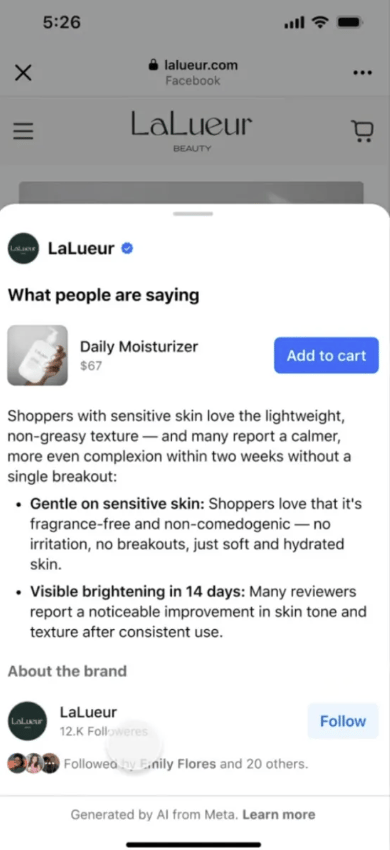
When someone clicks one of your ads on Facebook or Instagram, a pop-up now shows an AI-generated summary of what people are saying about your product. Think Amazon's AI review summaries, but appearing before the customer reaches your site. Before they've committed to anything. Before they've even decided whether you're worth a second look.
The pop-up also surfaces brand information, recommended products, and available discounts. It's essentially a pre-purchase due diligence report that Meta compiles on your behalf, whether you asked for it or not.
If your reviews are strong and consistent, this is free social proof delivered at the exact moment it matters most. If your reviews are thin, contradictory, or peppered with recurring complaints about shipping times or product quality... well, Meta's AI will helpfully summarize all of that for potential customers too.
Review quality just became an ad performance variable. Let that sink in for a second. The thing you used to worry about after the sale is now actively shaping whether the sale happens at all.
One-Tap Checkout (Or: How to Bypass Your Entire Funnel in 0.3 Seconds)
Meta's updated checkout flow, built with Stripe and PayPal (with Adyen and Shopify integrations coming), lets customers complete purchases without ever leaving Instagram or Facebook. Brands like Fanatics and Quince are already in. Shoppable ads on Instagram Reels are next.
From a conversion standpoint, this is objectively great. Fewer steps, fewer drop-offs, fewer moments where someone gets distracted by a text from their mum and forgets they were about to buy a lamp.
From an "everything else" standpoint, it's considerably more complicated. When the entire transaction happens inside Meta, your website doesn't get visited. Your email capture at checkout doesn't fire. Your upsell flow doesn't trigger. Your carefully designed post-purchase experience — the one you spent three months building — gets skipped entirely.
You get the sale. Meta gets the relationship. Whether that trade-off works for your business depends entirely on your unit economics and how much lifetime value you're currently generating from those post-purchase touchpoints. (Spoiler: if you don't know that number, now would be an excellent time to find out.)
Your Products Now Need to Be Photogenic (For Robots)
Muse Spark can process images, not just text. Users can photograph a product and ask Meta AI how it compares to alternatives. They can scan a shelf and get ranked recommendations. Every phone camera just became a product comparison tool inside Meta's ecosystem.
This means how your product appears visually in photos, Reels, and user-generated content now directly influences whether the AI recommends you. It's not enough for your product to be good. It needs to look consistently recognizable across every context where it might appear.
If your hero images, your UGC, your creator content, and your lifestyle shots all present your product in wildly different ways, the AI struggles to identify it as the same thing. And an AI that can't confidently identify your product definitely isn't going to recommend it.
Visual consistency has always mattered for brand building. Now it matters for algorithmic survival.
Creators Are the New Search Algorithm
Meta expanded its affiliate partnerships for creators to include Amazon, eBay, and Temu in the US, plus Mercado Libre and Shopee internationally. Instagram Reels creators now get access to product catalogs from businesses in 22 countries.
Here's what this means practically: creators aren't just driving traffic anymore. They're feeding the recommendation engine. What creators feature in their content shapes what Muse Spark's shopping mode understands about your market, your category, and your competition.
If the top creators in your niche are featuring your competitors on Instagram and you're conspicuously absent, the AI is building its understanding of your category without you in it. You're not being compared unfavorably. You're not being compared at all. You simply don't exist in the model's version of reality.
Which is, arguably, worse.
What This Actually Means for Your Business
Your content now has two audiences. Human followers and Meta's AI. That lifestyle Reel with the gorgeous sunset and the moody music? Great for engagement. Useless for shopping mode if there's no clear product information the AI can extract. You need content that does both — entertains humans and informs machines. (A sentence I never expected to type, and yet here we are.)
Reviews are now pre-purchase infrastructure. If your post-purchase review request flow is an afterthought — a single email that goes out three days after delivery with a generic subject line — it's time for a rethink. Volume matters. Recency matters. And addressing recurring negative themes in your product or fulfillment matters even more, because the AI will faithfully summarize every pattern it finds.
Creator strategy needs to be Meta-specific. "We work with influencers" is no longer sufficient. You need creators who are active specifically on Instagram and Facebook, producing content that feeds into the ecosystem where Muse Spark operates. A creator with a massive YouTube following but minimal Instagram presence isn't moving the needle here.
Watch the Shopify integration closely. When Meta's Shopify checkout integration goes live, it'll simplify in-app checkout setup significantly. Being early to that integration while the audience is still forming new habits could give you a meaningful head start.
The Bottom Line for Sellers
Meta is building a closed-loop shopping system inside its apps, powered by an AI model that only sees what exists within Meta's ecosystem. Discovery, evaluation, and purchase — the entire customer journey — is being designed to happen without anyone ever needing to leave Instagram or open a new tab.
This doesn't mean you should rebuild your entire strategy around it tomorrow. Even Zuckerberg has tempered expectations, framing early models as demonstrations of progress rather than finished products. The rollout is US-first, with broader availability coming in waves.
But the direction is clear. And the sellers who start structuring their content, reviews, and creator relationships for this system now — rather than scrambling when it hits critical mass — will have a significant advantage over those who assumed their Google Shopping feed would remain the center of the universe forever.
Meta has 3+ billion users across its apps. If they get this right, the next version of "search" on Instagram won't be a search bar. It'll be a conversation. And what the AI recommends will depend entirely on the content you've already created.
No pressure.
Do You Love The AI For Ecommerce Sellers Newsletter?
You can help us!
Spread the word to your colleagues or friends who you think would benefit from our weekly insights 🙂 Simply forward this issue.
In addition, we are open to sponsorships. We have more than 66,000 subscribers with 75% of our readers based in the US. To get our rate card and more info, email us at [email protected]
The Quick Read:
Shopify’s new free app Tinker bundles 100+ AI tools into one mobile playground, making product shots, logos and videos far easier for founders who want to turn ideas into a brand fast.
OpenAI is testing ads in ChatGPT for Free and Go users in the U.S., betting on sponsored placements to fund wider access while keeping answers independent and advertiser hands off your chats.
Moz argues most brands are tracking AI search the wrong way, saying mentions matter more than citations and smart prompt coverage beats old SEO ranking habits.
One creator tracked two weeks of Claude use and found 10 repeatable workflows saved 11.4 hours a week, showing how structured prompting can quietly become a serious productivity engine.
New research suggests ranking for ChatGPT’s fan out queries is far from a guaranteed citation play, reinforcing that deep product led content and topical authority matter more than GEO hacks.
The Tools List:
✂️ Quso AI - Get social-ready clips, cut & captioned by AI.
🌐 Permar: Generate a conversion-rate-optimized landing page with a single prompt.
✒️ Descript: Your all-in-one content companion to write, record, transcribe, edit, collaborate, and share your videos and podcasts.
📹 Revid - Stunning product videos in minutes.
🤖 Before Sunset: An AI personal assistant that plans your day by automatically generating daily schedules.
About The Writer:

Jo Lambadjieva is an entrepreneur and AI expert in the e-commerce industry. She is the founder and CEO of Amazing Wave, an agency specializing in AI-driven solutions for e-commerce businesses. With over 13 years of experience in digital marketing, agency work, and e-commerce, Joanna has established herself as a thought leader in integrating AI technologies for business growth.
For Team and Agency AI training book an intro call here.