- AI for Ecommerce and Amazon Sellers
- Posts
- How AI Actually Decides Which Stores to Recommend
How AI Actually Decides Which Stores to Recommend
A new research

From Our Sponsor:

Early AI avatars were stiff and uncanny. Now? They're indistinguishable from real hosts and selling 24/7 in China.
AI isn't just optimizing ads anymore. In China, it's running entire storefronts, personalizing customer journeys, and closing sales 24/7. An average AI avatar generates $140K in GMV annually, boosting conversions 3-5x on Douyin and Taobao.
China’s social commerce game just changed. Don’t be left behind.
Inside:
Platform selection framework (WeChat vs. Douyin vs. Weibo)
5 content strategies Chinese consumers trust
KOL collaboration checklist
AI avatar opportunity breakdown
Metrics that actually matter
Stop guessing. Start selling.
How AI Actually Decides Which Stores to Recommend

Source: Anthony Lee/LinkedIn
Okay, so I've been following Anthony Lee's research posts for the past few weeks, and this guy has become my continuous source of fascinating new findings about AI search. If you're not already reading his work, you absolutely should check it out—he's been running these methodical experiments that completely expose how Answer Engine Optimization actually works versus how everyone thinks it works.
The llms.txt File That Nobody's Reading
Remember when everyone was convinced llms.txt files were the future? The idea was brilliantly simple: put this special file on your website to help AI chatbots understand your content better. Every consultant with a LinkedIn account was pushing it as the next big thing.
Anthony logged server traffic for 24 hours straight across multiple sites. Total number of AI platforms that looked for these files?
Zero.
Not ChatGPT, not Claude, not Perplexity. Even when he literally asked these platforms about his websites directly, they still ignored the llms.txt file. It's like installing a doorbell that nobody ever rings because they're all climbing through the window.
The Perplexity Reality Check
Here's where things get properly weird. Anthony asked Perplexity about a product called Slack Brain. Perplexity confidently declared that no such product existed. Meanwhile, the website was live, fully documented, just hanging out on the internet doing its thing.
The twist? Perplexity never even checked the server. This "real-time answer engine" was operating entirely from cached data while pretending to search the web. It's basically the digital equivalent of confidently giving directions to a restaurant you haven't visited in years.
ChatGPT was the only platform that actually visited sites during conversations, but—and this is the tragicomic part—it was fetching URLs from Bing's index that were so outdated, 11 out of 12 pages had been deleted. Imagine using a phone book from 2015 and wondering why all the numbers are disconnected.
The Reddit Plot Twist (With Important Context)
Now, here's where I need to add some nuance, because I've personally written about Reddit's importance in this newsletter before. The AEO/GEO landscape changes constantly—what worked last month might be useless today.
Anthony's data showed that across 120 queries, Reddit appeared first in Google results 138 times. Number of times AI platforms cited Reddit in that study? Zero.
But here's the thing: Reddit used to be a major source for AI citations, and I've covered that extensively. The fact that it's currently getting ignored doesn't mean it's permanently irrelevant—it means these platforms are continuously evolving their citation logic. Reddit might still be valuable for discovery and community building, but right now, the AI engines have apparently moved on to other sources. Next month? Who knows, they might be back to loving Reddit again.
This volatility is actually the most important lesson here. Any strategy that goes all-in on a single platform or tactic is basically gambling.
The YouTube Industrial Complex
While Reddit was getting the cold shoulder, YouTube was having its moment. Perplexity cited YouTube 70 times. ChatGPT cited it 43 times.
The platforms also showed serious preference for:
Wikipedia (obviously)
TechRadar (18 ChatGPT citations)
Forbes (also 18 times)
Consumer Reports (Perplexity gave it 5 citations)
Meanwhile, massive brands like The New York Times, Amazon, and Home Depot—despite dominating Google rankings—received exactly zero ChatGPT citations. Their SEO dominance translated to absolutely nothing in AI visibility.
The Discovery Query Problem Nobody's Talking About
Anthony classified nearly 20,000 search queries and found that 31.2% are "discovery queries"—people exploring options without specific brands in mind. Think "best coffee maker for small apartment" searches.
For these crucial queries, AI platforms skip brand websites entirely. They go straight to review aggregators and "Best X for Y" listicles. Your optimized product pages? Your compelling brand story? The AI ignores all of it in favor of G2, Capterra, and that TechRadar roundup from last year.
This forces brands to compete on platforms they don't control. You're essentially renting visibility instead of owning it.
The Analytics Black Hole
Here's the measurement nightmare: When ChatGPT mentions your brand, there's often no referral traffic. No click to track. No conversion to attribute. Your brand could be influencing thousands of purchases while your analytics dashboard shows tumbleweeds.
We've spent decades building sophisticated attribution models, and now we're back to the pre-digital equivalent of "I know advertising works, I just don't know which part." Except worse, because we can't even confirm the advertising is happening.
How Intent Changes Everything
The research revealed distinct citation patterns by query type:
Informational queries ("what is cryptocurrency"): Wikipedia gets 42.9% of citations
Discovery queries ("best CRM for small business"): Review sites dominate at 16-21%
Validation queries ("Salesforce pricing"): Brand sites finally matter
Comparison queries ("Notion vs Obsidian"): Publishers win at 20%
Review queries ("iPhone 15 reviews"): YouTube and TechRadar lead
The brutal math: Only 3.2% of queries are validation queries where your website is the preferred source. For everything else, AI platforms prefer third-party content.
The Practical Reality of What to Do
Based on Anthony's findings, here's what actually matters:
Review platform presence is non-negotiable. G2, Capterra, Trustpilot—these aren't marketing channels anymore, they're essential infrastructure. If you're not there with substantial review volume, you're invisible to discovery queries.
YouTube content is mandatory. Not optional, not nice-to-have. The platforms consistently cite YouTube across multiple query types. No YouTube presence means surrendering a massive citation source.
Traditional SEO is a parallel game. Your Google rankings and AI citations operate independently. Ranking first on Google while being invisible to ChatGPT is increasingly common. You need separate strategies for each.
Attribution requires new thinking. Brand mention monitoring, sentiment tracking, and indirect influence measurement need to replace click-based attribution for AI-driven discovery.
Flexibility beats strategy. With platforms changing their citation preferences continuously, rigid long-term strategies are worthless. Build capabilities for rapid adaptation instead.
The Bottom Line for Sellers
We're in a transitional mess where traditional SEO still matters for Google traffic, but AI citations follow completely different rules that change quarterly (or faster). Your Reddit strategy from last year might be worthless today. Your YouTube investment might become critical tomorrow.
The only sustainable approach is to diversify presence across platforms, monitor everything obsessively, and be ready to pivot when citation patterns shift. Because they will shift. Probably by the time you finish reading this.
Welcome to the future of commerce discovery. It's more volatile than crypto markets, less predictable than algorithm updates, and absolutely essential for anyone selling online.
I Just Got On TikTok!
Yes, I know I am fashionably late , but guess what… talking on camera is just so cringe and yet, I am committed. If you want to get more AI ecom content served as a video edition, while watching me learn how not to cringe live, you can follow me here.

The Quick Read:
Opus 4.5 feels like a new tier of autonomous coding, shipping without spiraling into error loops and enabling prompt-native apps where features are written as prompts, not code.
Google’s 2025 AI recap reads like a year of Gemini everywhere, from Search AI Mode and code help to Veo video, new TPUs, and more AI baked into everyday products.
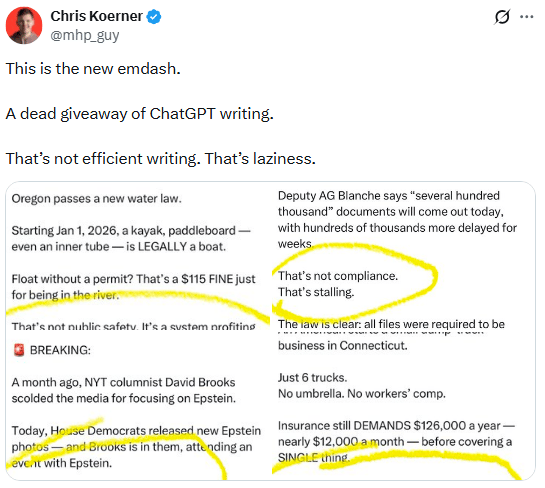
The new em dash, still here but in a different form.
Seven tech predictions for 2026 tees up the next big questions, IPO bets, Apple momentum, and whether a breakout AI device finally lands.
China is drafting tighter rules for emotionally interactive AI, including addiction warnings, stronger lifecycle safety duties, and limits on harmful content.
A 2026 hot take says Opus 4.5 made coding feel unlimited, and the next leap could unleash mainstream app building where time is the only real cost.
Google’s 2026 marketing forecast bets on present-focused wellbeing, AI-shaped discovery, co-creation culture, nostalgic remixes, and sustainability framed as tangible value.
VCs expect 2026 to bring real workforce impact as budgets shift from labor to AI, with agents moving from productivity booster to genuine task automation.
Meta buys Manus for more than $2 billion!!!
New traffic-share numbers show ChatGPT slipping under 70% while Gemini surges toward 20%, and Grok keeps climbing as the LLM traffic pie rebalances.
The Tools List:
🎨 Recraft - Create and edit graphics in a uniform brand style
📽️ HeyGen GPT - Transform text into lifelike and customized videos instantly
📊 Sheet Savvy AI - Use AI to save hours on repetitive tasks in Google Sheets.
💻 Brainner - Optimize talent acquisition through automated, AI-powered resume analysis.
📧 Instant Summaries by Shortwave - Smart TL;DRs for every email.
🌄 Pikzels AI - Create AI-generated thumbnails effortlessly
About The Writer:

Jo Lambadjieva is an entrepreneur and AI expert in the e-commerce industry. She is the founder and CEO of Amazing Wave, an agency specializing in AI-driven solutions for e-commerce businesses. With over 13 years of experience in digital marketing, agency work, and e-commerce, Joanna has established herself as a thought leader in integrating AI technologies for business growth.
For Team and Agency AI training book an intro call here.