- AI for Ecommerce and Amazon Sellers
- Posts
- Google Just Patented the Right to Replace Your Landing Page.
Google Just Patented the Right to Replace Your Landing Page.
And Charge You for the Privilege.

Jo Lambadjieva
March 18, 2026
In partnership with


From Our Sponsor:
The ops hire that onboards in 30 seconds.

Viktor is an AI coworker that lives in Slack, right where your team already works.
Message Viktor like a teammate: "pull last quarter's revenue by channel," or "build a dashboard for our board meeting."
Viktor connects to your tools, does the work, and delivers the actual report, spreadsheet, or dashboard. Not a summary. The real thing.
There’s no new software to adopt and no one to train.
Most teams start with one task. Within a week, Viktor is handling half of their ops.
Google Just Patented the Right to Replace Your Landing Page. And Charge You for the Privilege.
The Patent Nobody Asked For
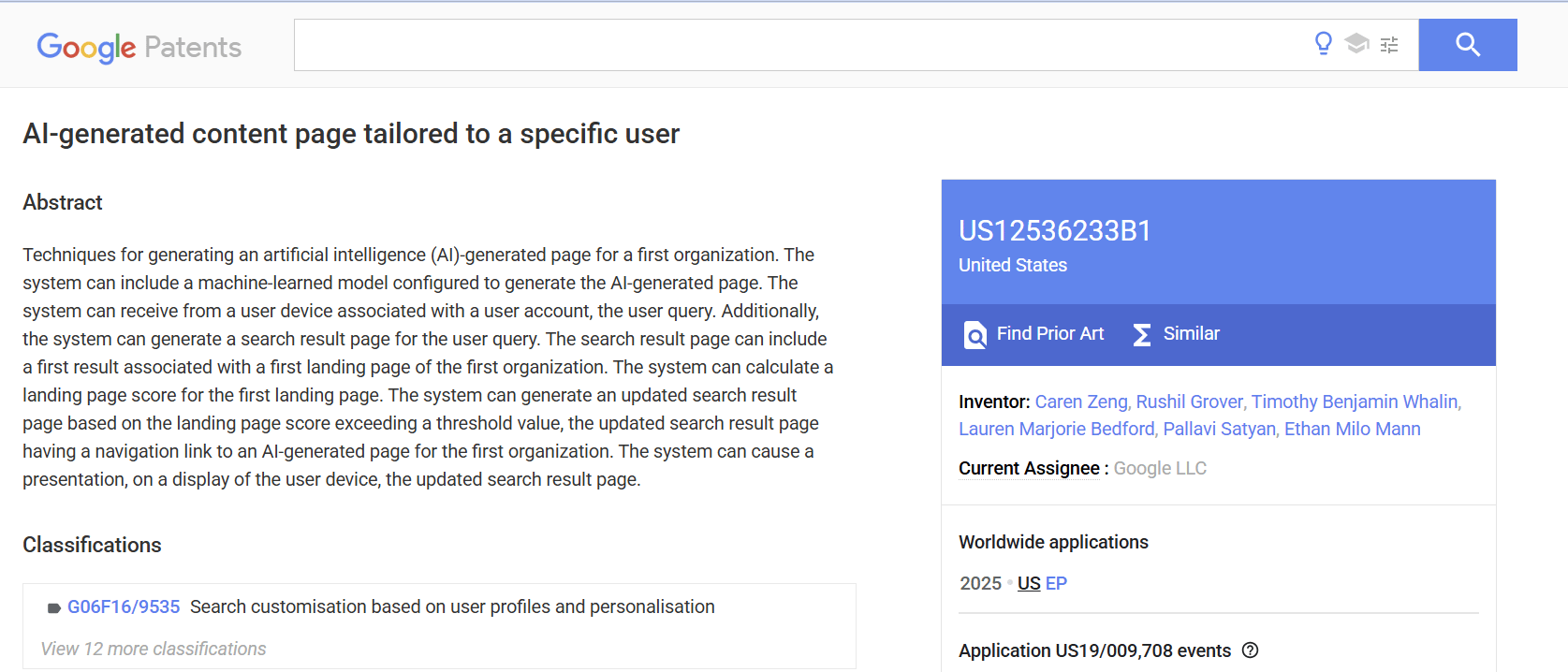
On January 27th, 2026, the US Patent and Trademark Office granted Google patent US12536233B1, titled "AI-generated content page tailored to a specific user." The provisional application was filed back in July 2024, with a parallel European filing in July 2025. The search and advertising community has been... processing this.
Here's what the patent actually describes: Google scores your landing page in real time when a user searches. If the score crosses a threshold — based on conversion rate, bounce rate, click-through rate, or what the patent charmingly calls "page design quality or content quality" — the system triggers an AI-generated replacement page. That replacement gets inserted into the search results via a navigation link. Including, and this is the part worth reading twice, within a sponsored content item.
So: you bid on the keyword, you win the auction, you pay for the click, and the user lands on a page Google built. One that you didn't design, didn't approve, and can't edit. It's like hiring a contractor to renovate your kitchen and coming home to find they've replaced your entire house. But they still sent you the invoice.
The "Not Good Enough" Bar Is Remarkably Low
The patent lists several triggers for replacement, but one stands out: the system can flag a landing page when it "does not have a filter for products."
That's it. No product filter? You're eligible for replacement.
Think about how many mid-market ecommerce campaign pages, category pages, and brand landing pages would fail that test. This isn't targeting the obvious disasters — the 2009-era landing pages with auto-playing music and a broken contact form. This threshold would catch a huge swath of pages currently running Google Ads traffic right now.
Landing page quality already affects Quality Score and minimum CPCs — that's not new. What's new is the leap from penalising your page in the auction to replacing your page entirely. Without requesting consent. And potentially without telling you it happened. (Google's version of "we fixed it for you" energy, except the "it" is your entire customer experience.)
What Google's Replacement Page Actually Looks Like
The AI-generated page isn't some generic template with your logo slapped on it. According to the patent, the system processes the user's current query and their account-level contextual data — including previous searches — to assemble a personalised page.
The pipeline includes four generation modules: text, image, audio, and video. An optimiser and ranking module processes the outputs. There's even a feedback layer where user interaction triggers regeneration of individual components.
The assembled page can include personalised headlines, suggested filters, product clusters, CTAs, a product feed, site links, and — because apparently we're just doing this now — an AI chatbot.
The patent's own example: a user who previously searched "best laptop for architecture" and "best laptop for 3D modelling" later gets served an AI-assembled page built around that research path. Not the advertiser's website. A version Google's model constructed from what it determined was most relevant.
Which is impressive technically. And terrifying commercially.
Four Problems, All of Them Serious
Brand control evaporates. An AI-generated page assembled from search history and model outputs doesn't follow your brand guidelines. It doesn't know about your current promotion. It doesn't include your required regulatory language. It might present pricing that's wrong, product information that's outdated, or claims you never made. The patent doesn't address any of this. (Presumably because addressing it would require acknowledging it's a problem, and the patent is too busy being excited about dynamic content generation.)
Attribution gets even more opaque. Google Ads attribution is already a trust exercise in Performance Max and AI Max campaigns. Now add a layer where the destination page itself is unknown to the advertiser. You can't A/B test a page you didn't build. You can't run CRO tools on a page you can't access. You receive conversion signals — maybe — from a surface you have zero visibility into. The ANA's Q2 2025 Programmatic Transparency Benchmark estimated lost global media value in programmatic advertising hit $26.8 billion in 2025, up 34% from 2024. And that was before the destination page itself became a variable you don't control.
You're paying for traffic to someone else's page. Under claim 12, the navigation link to the AI-generated page can sit inside a sponsored content item. Your budget funds clicks to a Google-built page. Any downstream conversion attribution flows through Google's own measurement infrastructure. At this point, the advertiser's role in the transaction is essentially "person who writes the cheque." (A role most of us are already uncomfortably familiar with, but at least previously we got to pick the curtains.)
There's no described opt-out. The patent describes the system making the replacement decision autonomously. No opt-in mechanism appears in the document. Whether Google would actually require advertiser consent before deploying this commercially is an open question — but the fact that the patent doesn't even gesture toward one is telling.
This Isn't an Isolated Patent. It's the Missing Piece.
Read this patent in isolation and it looks like a thought experiment. Read it alongside everything Google has shipped in the past 18 months and it starts looking like the last piece of a jigsaw puzzle nobody wanted completed.
October 2024: Google overhauled Shopping with Gemini-powered personalised feeds and AI-generated product briefs. Ads started appearing in AI Overviews for US mobile users. By December 2025, the format had expanded to 11 countries.
January 2026 — two weeks before this patent was granted — Google launched the Universal Commerce Protocol, an open-source standard for AI agents to execute purchases across retail platforms. The same day, Target and Walmart enabled checkout directly within Gemini and AI Mode.
February 2026: Google introduced shopping ad formats for AI Mode, which by then had more than 75 million daily active users.
So: AI Overviews handle product discovery at the top of the funnel. The Universal Commerce Protocol and Gemini checkout handle the transaction at the bottom. This patent describes a system for the middle — the landing page moment — which has been the one remaining point where advertisers actually controlled the user experience.
The logical endpoint, if every component reaches deployment, is a Google-owned commerce surface where brands purchase placement, Google builds the storefront, Google facilitates the transaction, and the brand receives an order notification. Your website becomes a fulfilment backend. Your brand exists at the pleasure of a model.
That's not speculation. It's the sequential assembly of announced, live, and patent-protected products.
Who Gets Hit First
The scoring mechanism would disproportionately affect ecommerce brands running mid-tier Google Ads campaigns to campaign-specific or category landing pages. These pages — built for volume, often with thin content, no product filter, and conversion rates that reflect the gap between paid traffic quality and page readiness — are exactly what the patent's trigger conditions describe.
Amazon sellers using Google Ads to drive external traffic to product listings or storefronts are also in scope. A product detail page or Amazon storefront could plausibly fail the "filter for products" threshold as Google's model interprets it.
The brands with the most structural resilience are those that have invested in entity-level content: structured data, well-organised Q&A content, factual accuracy, and strong semantic signals. If Google's model is assembling a replacement page by drawing on available content about a brand, the brands with the clearest, most well-structured content become the dominant sources for that assembly. The brands with thin or inconsistent web presence get displaced — or get their page replaced with something hallucinated from weaker signals.
The Unresolved Questions (There Are Several)
Privacy. The system relies on previous search queries and contextual user account data to personalise generated pages. Under GDPR, generating a personalised page for a third-party advertiser using profiling data requires a lawful basis under Article 6. Google filed the parallel European application in July 2025, which suggests they intend to pursue this in European markets. Whether they can remains untested.
Cross-brand contamination. Claim 2 of the patent states that an AI-generated page "can be presented to another organisation that is different from the first organisation" and "can be utilised for future search." A page assembled for one advertiser's query could potentially surface for a different brand later. The IP and brand safety implications of that sentence alone could fuel a year of litigation.
Implementation. A patent is intellectual property protection, not a product announcement. Google hasn't confirmed plans to deploy this commercially. But they filed for it, pursued it through examination, and were granted it. Patents aren't free. Companies don't protect capabilities they have no intention of building toward.
The Bottom Line
Whether or not this specific patent reaches production in its current form is almost beside the point. The architecture is being assembled. The direction is clear. Each successive product gives Google more control over more of the commerce funnel, and the advertiser's domain of influence shrinks accordingly.
The ecommerce operators building resilience now — through owned channels, diversified discovery, structured product data, and AEO investment — are the ones least likely to wake up and discover Google has redecorated their storefront without asking.
Everyone else is building on ground that's shifting beneath them. Slowly, deliberately, and with full patent protection.
P.S. — "AI-generated content page tailored to a specific user" is doing a lot of heavy lifting as a title. "System That Replaces Your Website and Bills You For It" was presumably workshopped and rejected.
P.P.S. — If your landing page doesn't have a product filter, this might be a good week to add one. Not because a product filter will save you from the broader implications of this patent. But because it's the lowest bar Google described, and clearing it at least buys you time while you figure out the rest.
Do You Want To Learn About AEO Weekly?
I started writing a second newsletter. Once a week.
One topic: AI Search Optimization.
You can check it out here or click below.
The Quick Read:
ChatGPT 5.4 may have hidden fan-out queries from the console, but not from the API, giving power users a new Python route to uncover the search paths behind responses.
Claude Code desktop now supports local scheduled tasks, opening the door to recurring automations like log checks, PR creation and other always-on workflows while your computer is awake.
The real AI risk may be subtler than job loss: relying on finished answers too fast can quietly weaken your own thinking unless you keep your brain in the loop.
Meta is reportedly building new retail media tools that could finally show whether Facebook and Instagram ads are driving actual product sales, not just clicks and impressions.
SE Ranking’s latest study argues Google AI Mode is citing Google.com at striking rates, suggesting users are being looped back into Google’s own ecosystem more than ever.
Gemini can now help you with… everything. Whether it is docs, slides, sheet or other Google tools. Everything in one place!
The Tools List:
Sesame - A Creative Tool Purpose-built for Brand Expression
🖼️ Tila - Infinite AI canvas. Top neural networks in a single hub
⚙️ Agent Minimax - Research, PPT, Code and more with Minimax . A global AI foundation model company.
✍️ SEO.ing - Your Go-To Solution for Quick, Effective, and SEO-Optimized Article Writing
🖼️ Krea 1 - Powerful free AI image generator
🧑🏫 PI Presentation Intelligence - Ai-Native Design & Sharing Platform, generate presentations in seconds.
About The Writer:

Jo Lambadjieva is an entrepreneur and AI expert in the e-commerce industry. She is the founder and CEO of Amazing Wave, an agency specializing in AI-driven solutions for e-commerce businesses. With over 13 years of experience in digital marketing, agency work, and e-commerce, Joanna has established herself as a thought leader in integrating AI technologies for business growth.
For Team and Agency AI training book an intro call here.