- AI for Ecommerce and Amazon Sellers
- Posts
- Everything You Need to Know About Google's AI Shopping Protocol
Everything You Need to Know About Google's AI Shopping Protocol
Before It Starts Shopping For Your Customer

Jo Lambadjieva
April 01, 2026
Sponsored by


From Our Sponsor:
Replace your first 4 hires with AI. Free workshop on April 8th.

Most early-stage founders can't afford their first four hires. Sales, marketing, dev, and support alone can run hundreds of thousands in salaries.
On April 8th, AI thought leader Heather Murray shows pre-seed and seed founders how to build all four functions using AI tools. Live, with demos, for free.
Register today and get a free AI tech stack worth $5K+ including Claude, AWS credits, Make, and 90% off HubSpot.
Everything You Need to Know About Google's AI Shopping Protocol — Before It Starts Shopping For Your Customer
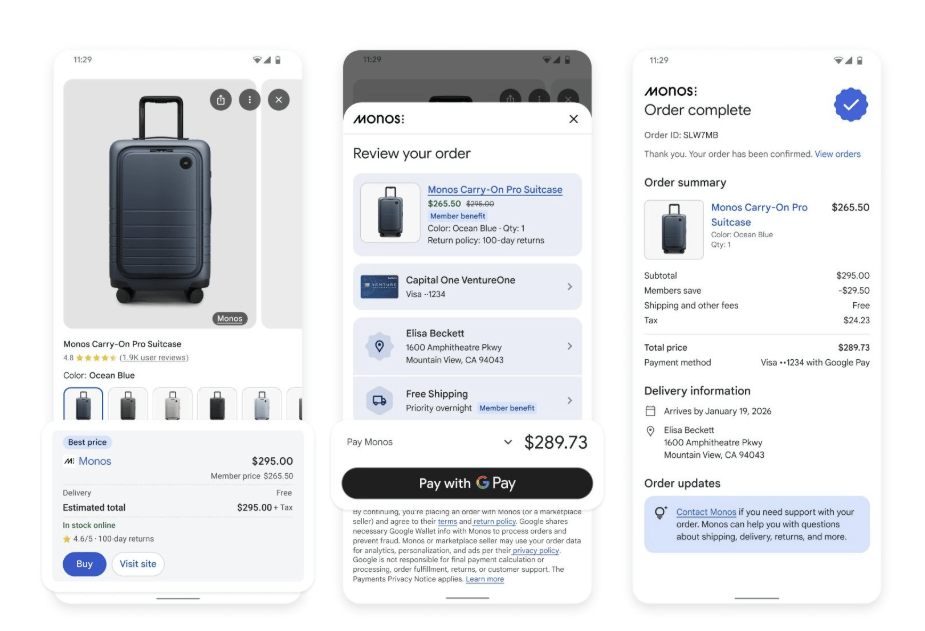
Example Query: "Find a light-weight suitcase for an upcoming trip." Source: Google
You know what's a solved problem in ecommerce? Shopping carts. Literally every online store on the planet figured this out sometime around 2004. Your nan's knitting supply website has a functioning shopping cart.
So naturally, when Google launched their Universal Commerce Protocol back in January — their grand vision for AI agents that can browse, evaluate, and buy products without ever leaving Google's own AI experience — they shipped it without a shopping cart. One item at a time. Like some kind of artisanal, hand-crafted purchasing experience where every transaction is a bespoke event.
Three months later, they've added multi-item carts, live inventory data, and loyalty programme integration. Which is a bit like a car company proudly announcing they've now included all four wheels. But beneath the absurdity of the timeline, something genuinely significant is happening — and if you're selling products online, you need to understand it before your competitors do.
What UCP Actually Is (The Non-Corporate Version)
Strip away the acronym soup and here's what Google built: a standardised way for AI agents to talk directly to a retailer's product catalogue, understand what's available, and complete purchases — all without the shopper ever visiting your website.
Read that last bit again. Without the shopper ever visiting your website.
For decades, online shopping has worked on a simple handoff model. Google (or Bing, or whoever) sends traffic your way, and then your beautifully designed product page does the converting. You control the experience. The search engine's job ends at the click.
UCP flips that entirely. The AI becomes the storefront. Your product page becomes... optional. That homepage you spent $15,000 redesigning last year? The AI agent has never seen it and doesn't care.
Google built this alongside Shopify, Walmart, Target, Wayfair, and Etsy, with Stripe handling payments. That's not a side project. That's a coalition of companies that collectively move a terrifying percentage of global ecommerce. When those names show up together on a press release, it's worth paying attention — even if the press release is basically announcing they've discovered shopping carts.
The Three Updates (AKA: Catching Up to 2008)
The new capabilities are Cart, Catalog, and Identity Linking. Let's walk through them, trying very hard not to be sarcastic about the fact that these are being treated as breakthroughs.
Cart lets AI agents add multiple items from the same retailer into a single basket. Previously — and I genuinely wish I was making this up — UCP only supported buying one item at a time. Nobody shops like that. Even my impulse purchases come in pairs. The absence of this at launch was the kind of oversight that makes you wonder if anyone on the development team has ever actually bought groceries.
Catalog gives agents access to real-time product details: variants, pricing, stock levels. Before this update, the AI was essentially recommending products while having no idea whether they were in stock, how much they actually cost, or whether they came in blue. It was like asking a friend for restaurant recommendations and they suggest a place that closed three years ago. Every time.
Identity Linking is where things get strategically interesting. It lets shoppers keep their logged-in benefits — loyalty pricing, member discounts, free shipping thresholds — even when purchasing through an AI agent instead of directly on the retailer's site. Without this, every UCP transaction treated the customer as an anonymous guest, which meant retailers were actively punishing their best customers for using the new shopping channel. Nothing says "we value your loyalty" quite like stripping away all the perks the moment someone uses your AI integration.
The Protocol War Nobody Wants
Google isn't the only one building agentic commerce plumbing. OpenAI and Stripe co-developed the Agentic Commerce Protocol — a competing standard designed for shopping inside ChatGPT. Because obviously what ecommerce needs right now is another format war.
But here's where it gets interesting: OpenAI appears to be quietly backing away from direct in-chat commerce, shifting checkout into separate ChatGPT apps rather than handling it natively in conversation. When the biggest potential platform for your protocol starts retreating from the use case your protocol was designed for, that's... not ideal.
Stripe, notably, already supports both protocols. They're the Switzerland of payment infrastructure — neutral, efficient, and profiting handsomely from everyone else's territorial disputes.
The historical parallels write themselves. VHS versus Betamax. Blu-ray versus HD DVD. Every format war produces a period of confusion that benefits absolutely nobody, followed by consolidation around whoever had better distribution. The difference here is that retailers building their tech stack around one protocol are making investments that are genuinely painful to reverse.
There's a reasonable argument that UCP's best shot at becoming a true universal standard — something like TCP/IP but for buying things — would involve Google handing governance to an independent body. Give Shopify, Stripe, Walmart, and even Amazon seats at the table. Reduce the (entirely justified) suspicion that adopting UCP means handing Google even more control over your business.
Whether Google has any incentive to do this while they're winning is, of course, a completely separate question. (Spoiler: they don't.)
What This Actually Means If You Sell Things
Right. Practical implications. The bit you actually came here for.
Your product data just became your most important competitive asset. In a world where AI agents are deciding which products to recommend, the quality and completeness of your structured data determines whether you even exist. Titles, descriptions, GTINs, imagery, accurate pricing, real-time inventory, structured attributes — all of it feeds the AI's decision-making. Incomplete data doesn't just hurt your ranking. It removes you from consideration entirely. The AI doesn't show your product and apologise. It just... doesn't show your product.
This is a meaningful shift from how most sellers have treated product feeds. For years, feeds were basically a mechanism for getting into Google Shopping ads — a box-ticking exercise that someone on the team handled between other tasks. Under UCP, your feed becomes the primary interface between your business and the AI layer that's making purchasing decisions on behalf of your customers.
Merchant Centre is now critical infrastructure. Google is simplifying UCP onboarding through Merchant Centre, with partners including Salesforce, Stripe, and Commerce Inc implementing UCP on their platforms. That lowers the technical barrier. But the core requirement doesn't change: your Merchant Centre data needs to be accurate, complete, and synchronised with what's actually on your site. When Google's AI spots discrepancies between your feed and your website — pricing mismatches, availability errors, missing attributes — trust drops. And so does visibility.
Your funnel is compressing into a single interaction. When checkout happens inside Google's AI interface, the traditional path — search, click, land, browse, add to cart, convert — collapses into one conversation. Your product page may never be visited. The AI handles discovery, comparison, and purchase before a shopper ever reaches your domain. Your website isn't irrelevant, but the decisive moment of competition is moving upstream, into the AI's recommendation logic.
If you have a loyalty programme, integrate it now. Identity Linking means your loyal customers can keep their perks when shopping through AI agents. If you don't integrate, those customers get treated as anonymous guests — a worse experience that undermines the entire point of the loyalty programme you've been building.
Early movers will compound their advantage. Google has been explicit that UCP is modular — you can adopt capabilities incrementally. But the sellers who integrate fully and early will have the most complete data when AI agents start making purchasing decisions at scale. This isn't a 2028 problem. Google is already rolling UCP capabilities into AI Mode in Search and the Gemini app. The infrastructure is live.
The Bottom Line for Sellers
There's a delicious irony in agentic commerce spending its first few months rebuilding capabilities that traditional ecommerce sorted out years ago. Shopping carts. Inventory checks. Remembering who your loyal customers are. Genuinely groundbreaking stuff.
But the snark, while earned, risks missing what's structurally happening. UCP isn't just replicating old features inside a chatbot. It's relocating where the sale happens. When the AI agent becomes the storefront, the competitive landscape reorganises around an entirely different set of inputs: data quality, feed accuracy, structured attributes, and whether your catalogue is legible to machines rather than just to humans.
The sellers who treat their product data as a strategic asset — not an admin task they delegate to whoever drew the short straw — will be the ones positioned when the AI starts doing the buying. Everyone else will be wondering why their traffic disappeared and their beautifully redesigned homepage isn't getting any visitors.
Do You Love The AI For Ecommerce Sellers Newsletter?
You can help us!
Spread the word to your colleagues or friends who you think would benefit from our weekly insights 🙂 Simply forward this issue.
In addition, we are open to sponsorships. We have more than 66,000 subscribers with 75% of our readers based in the US. To get our rate card and more info, email us at [email protected]
The Quick Read:
Google is testing AI rewritten search titles, raising fresh fears that publishers could lose control of how their stories appear, and how much traffic still reaches the open web.
Amazon may be building a new AI first smartphone called Transformer, a surprising second shot at mobile that could turn shopping, Alexa and Prime into one tightly bundled device.
A sharp reading list for CMOs entering AI search, covering buyer behaviour, broken KPIs, AI Mode, tracking chaos and the tactical mechanics behind visibility.
ChatGPT’s new Library quietly stores your uploaded files for reuse across chats, making workflows smoother but adding a new layer of questions around control, retention and privacy.
Anthropic has shipped so much in 2026 that Claude now feels less like a chatbot and more like a full work system, with bigger context, new modes and real operational depth.
Klaviyo’s latest release pushes beyond AI assistance into AI execution, giving brands agents that can build campaigns, handle support and personalise outreach with far less manual work.
Coinbase is racing to become the payment rail for AI agents, betting that crypto wallets, stablecoins and micropayments could power the next wave of machine to machine commerce.
The Tools List:
🌊 Shortwave AI Assistant on iOS - Write, search, and analyze your emails with AI on the go.
🤖 AgentX: Build an AI agent chatbot for your business in less than 5 minutes.
🚨 Sixty AI: Runs in the background of your devices, managing all your incoming messages, invites and alerts and only interrupting you when it’s really important.
⚙️ Taskade AI: An AI-powered team organizer to simplify the way your team works. Taskade helps you distribute work among team members to get work done faster and smarter.
🎨 BrandWellAI: The All-in-One Content Marketing Platform that Drives Growth, Designed for Marketers that Care
🚄 Kittl: Speed up your workflows with AI-powered design tools and gain instant access to a ton of stunning illustrations, fonts, photos, icons, and textures.
About The Writer:

Jo Lambadjieva is an entrepreneur and AI expert in the e-commerce industry. She is the founder and CEO of Amazing Wave, an agency specializing in AI-driven solutions for e-commerce businesses. With over 13 years of experience in digital marketing, agency work, and e-commerce, Joanna has established herself as a thought leader in integrating AI technologies for business growth.
For Team and Agency AI training book an intro call here.