- AI for Ecommerce and Amazon Sellers
- Posts
- Every New Shopify AI Update You Need To Know About
Every New Shopify AI Update You Need To Know About
A full overview of their Winter Announcements

Jo Lambadjieva
December 17, 2025

From Our Sponsor:

Live Workshop: Nano Banana Pro for Amazon Sellers
The Nano Banana Pro Live Workshop for Amazon sellers is not a webinar..
It is a live interactive workshop where you will be working w our friend Chris Rawlings, following along step by step to create your own first Amazon listing image set yourself with Nano Banana in live time.
This is a live event and only happening once. Click here to join now.
Every New Shopify AI Update You Need To Know About

I'm sitting here at 11 PM, third coffee getting cold, staring at Shopify's Winter '26 announcement and realizing we're all missing the actual story. Everyone's focused on the shiny AI features—"Ooh, ChatGPT can sell your products now!"—but that's not what's happening here.
What's actually happening is that Shopify just positioned itself to become the invisible infrastructure layer between every AI assistant and every purchase decision. And honestly? It's kind of brilliant. Also terrifying. Mostly both.
The Great Commerce Rewiring Nobody Saw Coming
Here's the thing that's been bugging me since Wednesday: Shopify announced something called "Agentic Storefronts" (which, can we talk about how every tech company is slapping "agentic" on everything now like it's 2021 and we're adding "NFT" to random nouns?). But beneath the buzzword nonsense is something genuinely game-changing.
They're basically saying: "Hey merchants, instead of panicking about ChatGPT and Perplexity eating your lunch, what if we just... made your entire catalog speak fluent AI?"
The system takes your product data—all those SKUs you've been meticulously organizing in spreadsheets since 2019—and translates it into something AI models can actually understand. When someone asks ChatGPT "I need a waterproof jacket for hiking in Scotland that doesn't make me look like a traffic cone," your orange-averse outdoor gear suddenly becomes discoverable.
But here's where it gets spicy: Shopify isn't just helping AI find your products. They're making sure that when AI decides to buy something, it has to go through Shopify's checkout. Every. Single. Time.
The Numbers That Made Me Spill My Coffee
During their Q3 earnings call , Harley Finkelstein, president of Shopify, dropped some stats that made me literally pause mid-sip:
AI-driven traffic to Shopify stores increased SEVENFOLD since January. Orders from AI searches? Up ELEVENFOLD.
And get this—67% of Gen Z shoppers used AI tools for holiday shopping. Sixty. Seven. Percent. That's not a trend anymore, that's a behavioral shift that's already happened while we were all arguing about whether ChatGPT could write decent product descriptions.
The Infrastructure Play That's Actually Kind of Genius
What Shopify's really doing here is more subtle than "we added AI features." They're building what I'm calling the "commerce translation layer" for the entire internet.
Think about it: Every AI system needs to understand products differently. ChatGPT thinks in natural language. Perplexity wants structured data. Microsoft Copilot has its own weird requirements (because of course it does).
Instead of merchants having to figure out how to format their vintage denim jacket descriptions for seventeen different AI platforms, Shopify Catalog does it automatically. One integration, multiple AI touchpoints. It's the commerce equivalent of Google Translate, except instead of languages, it's translating between "human who wants things" and "AI that finds things."
The Knowledge Base feature is particularly clever—merchants can upload their return policies, brand voice guidelines, and those FAQs they spent three weeks writing in 2020. Now when an AI agent is asked about your shipping to rural Montana, it actually knows your weird Tuesday-only FedEx arrangement.
The Developer Angle That Has Me Low-Key Excited
They released something called Model Context Protocol support (MCP). This basically means developers can now build AI agents that natively understand Shopify's entire ecosystem. You can validate API calls, detect errors, and generate production-ready code without having to decode Shopify's documentation for the 47th time.
But here's what's really happening: Shopify is trying to become the default commerce layer that every AI agent calls when it's time to actually buy something. They're not competing with AI—they're becoming AI's favorite shopping mall.
Sidekick Got Scary Good (And I Mean That Literally)

Remember Sidekick, Shopify's AI assistant that everyone kind of ignored? Well, it just learned some new tricks that are making me question my job security.
It now proactively suggests things without being asked. Like that friend who notices you're wearing the same shirt three days in a row and gently suggests doing laundry. Except instead of hygiene advice, it's telling you that your conversion rate dropped 12% and here's probably why.
The thing can now build entire admin apps from a conversation. You literally tell it "I need something that tracks returns by product category and sends me a Slack message when denim returns exceed 10%" and boom—custom app.
One co-founder mentioned tasks that took "hours upon hours" now complete in minutes. Which is great for productivity but slightly concerning for those of us who bill by the hour (kidding... mostly).
The SimGym Thing That's Actually Hilarious
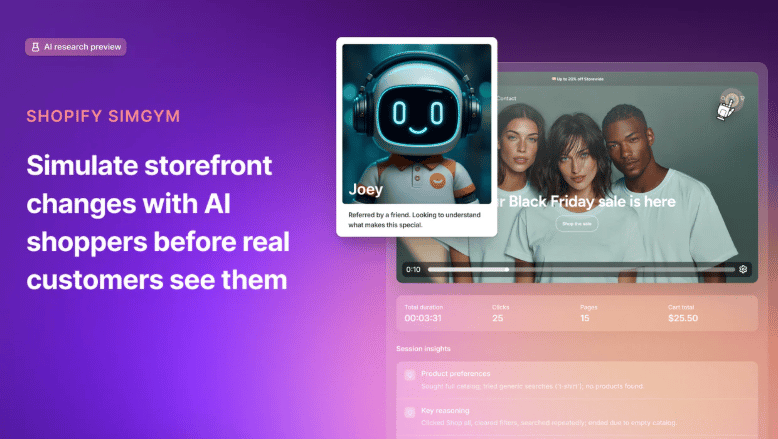
They introduced SimGym, which is basically The Sims but for your online store. AI shoppers with fake personalities browse your site, add things to cart, abandon them (just like real customers!), and generate data about what's working.
I cannot express how dystopian yet useful this is. We're literally creating fake people to shop at our fake stores to generate real insights. We've reached peak 2025 and I don't know how to feel about it.
Product Network: The Commission-Based Chaos Engine
This one's wild. Merchants can now show products from OTHER Shopify stores on their site. When someone buys, the original merchant gets a commission.
It's like affiliate marketing had a baby with dropshipping, except nobody has to actually manage inventory or relationships. Your sustainable soap store could automatically recommend complementary products from that artisan towel maker in Vermont, and you get paid when someone buys.
The algorithmic curation means you're not manually picking products—the AI decides what your customers might want based on... honestly, probably better data than you have. It's simultaneously brilliant and slightly unnerving.
The Existential Questions Keeping Me Up at Night
Here's what's really messing with my head: Shopify is essentially betting that commerce will consolidate around a few infrastructure providers who translate between merchants and AI systems.
But what happens when OpenAI decides to build their own commerce layer? What if Google gets jealous and blocks Shopify from their AI? What if Amazon wakes up and realizes they should probably pay attention to this?
The technical architecture faces massive scaling challenges. As AI agents get more sophisticated—comparing 50 products across 30 attributes while negotiating delivery times and coordinating multi-vendor orders—the data requirements become insane. Shopify Catalog has to maintain perfect accuracy across millions of products, real-time inventory, dynamic pricing, and the seventeen different return policies you created when you were "testing things."
What This Actually Means for Your Business
Look, I'm not going to pretend this is all sunshine and AI-powered rainbows. This shift creates real challenges:
The Visibility Trap: If your products aren't properly structured for AI interpretation, you might as well not exist. That handcrafted product description you spent three hours perfecting? Meaningless if an AI can't parse it.
Platform Lock-in 2.0: We're potentially trading Google's search monopoly for Shopify's infrastructure monopoly. Sure, it's convenient now, but what happens when they decide to take a bigger cut?
The Attribution Nightmare: When a customer discovers your product through ChatGPT, considers it in Perplexity, and buys it through Microsoft Copilot, good luck figuring out your actual CAC.
The Bottom Line (After Too Much Coffee)
Shopify's Winter '26 release isn't about adding AI features. It's about becoming the essential plumbing for how AI systems will handle commerce for the next decade.
They're betting that merchants will prefer one integration that handles everything rather than building individual connections to every AI platform that launches (and trust me, there will be hundreds). They're probably right.
For smaller merchants especially, this is a lifeline. You don't need a technical team to make your products discoverable in AI chats. You just need Shopify Plus (or regular Shopify, whenever they actually roll this out—reports suggest it's still pretty limited despite the big announcement).
The weird part? We're essentially accepting that the future of commerce runs through conversational interfaces we don't control, formatted by systems we don't fully understand, for customers whose journey we can barely track.
But then again, we already handed over most of our customer acquisition to social media algorithms we definitely don't understand, so maybe this is just the next logical step in our slow surrender to the machines.
At least Shopify's making sure we still get paid when the robots do the selling.
P.S. - If you're a Shopify merchant frantically checking your admin panel for these features and not seeing them, you're not alone. The rollout is... let's call it "selective" right now. Classic Shopify—announce first, ship eventually..
P.P.S. - "Agentic Storefronts" is definitely going on my list of "tech terms that sound important but mean nothing to normal humans," right next to "synergistic blockchain solutions" and "quantum-ready infrastructure." The future is weird, folks.
Do You Love The AI For Ecommerce Sellers Newsletter?
You can help us!
Spread the word to your colleagues or friends who you think would benefit from our weekly insights 🙂 Simply forward this issue.
In addition, we are open to sponsorships. We have more than 60,000 subscribers with 75% of our readers based in the US. To get our rate card and more info, email us at [email protected]
The Quick Read:
How America’s Biggest Retailers Are Rethinking Their Businesses And Their Stores
Most “AI transformation” is theater, real change starts when CEOs use the tools themselves, set AI-first rules, and are willing to cannibalize legacy revenue before the market does it for them.
Gemini and Nano Banana fans are swapping prompt hacks fast, the takeaway is simple, the best prompts are specific, constrained, and built like a brief not a vibe.
The $700 Billion AI Productivity Problem No One's Talking About
Short vs. Long Content in AI Overviews?
Want to clone an image aesthetic fast? Use Gemini vision to extract style into a JSON “style file” you can reuse, turning inspiration into a repeatable brand system.
OpenAI says ChatGPT has no ads, but admits promo-like suggestions felt adjacent
Gemini in Chrome - an awesome trick you probably didn’t know about.
Opus 4.5 signals a step up in autonomous coding, it keeps building without error spirals, and makes prompt-native apps real where features become prompts, not code.
Stop asking LLMs what “they” think, treat them as simulators, ask for the best set of viewpoints and what each would argue, and you get sharper thinking with less mystique.
Google just made MCP enterprise-ready with managed remote servers for Maps, BigQuery, GCE and GKE plus governance, basically USB-C for agents but with IAM, audit logs, and guardrails.
Trump’s White House is moving to bulldoze state AI rules via lawsuits and grant leverage to force a single federal standard, setting up a messy court fight and a GOP civil war over “Big Tech amnesty.
The Tools List:
💻 Keak - It automatically generates concrete website variations, tests their effectiveness, and improves your measurable results seamlessly.
🤖 Humva - Custom AI video avatar
🌐 Browser Use - We enable AI to control your browser.
🗺️ Recap - Turns learning materials into insightful visuals like mind maps and timelines for better understanding.
📃 GetWebsite Report - AI Agent to audit your website for SEO & Conversion.
About The Writer:

Jo Lambadjieva is an entrepreneur and AI expert in the e-commerce industry. She is the founder and CEO of Amazing Wave, an agency specializing in AI-driven solutions for e-commerce businesses. With over 13 years of experience in digital marketing, agency work, and e-commerce, Joanna has established herself as a thought leader in integrating AI technologies for business growth.
For Team and Agency AI training book an intro call here.