- AI for Ecommerce and Amazon Sellers
- Posts
- Claude Just Made Your SaaS Stack Look Really, Really Expensive
Claude Just Made Your SaaS Stack Look Really, Really Expensive
How Anthropic's coding agent is rattling a trillion-dollar software industry—and why your ops team should be paying very close attention.

Jo Lambadjieva
February 20, 2026

Don’t Miss This:
Shameless plug: I run a weekly AI Search Optimisation newsletter because this topic moves so fast that by the time I finish writing about it in AI for Ecom, three new things have already broken. It's where I go deep on how AI is reshaping how customers actually find products—schema markup, structured data, optimising for AI answers instead of blue links, and decoding what Google, OpenAI, and Perplexity are really up to behind the press releases. Think of it as the cheat sheet for not getting made invisible by algorithms you didn't know existed.
Already subscribed? You have impeccable judgment and I appreciate you. Not yet? It's free, it's weekly, and it's written by someone who genuinely cannot stop reading about this stuff at 2 AM. Subscribe here before AI search optimises you out of the conversation entirely.
If you are to read one thing today, make it this one:

Claude Just Made Your SaaS Stack Look Really, Really Expensive
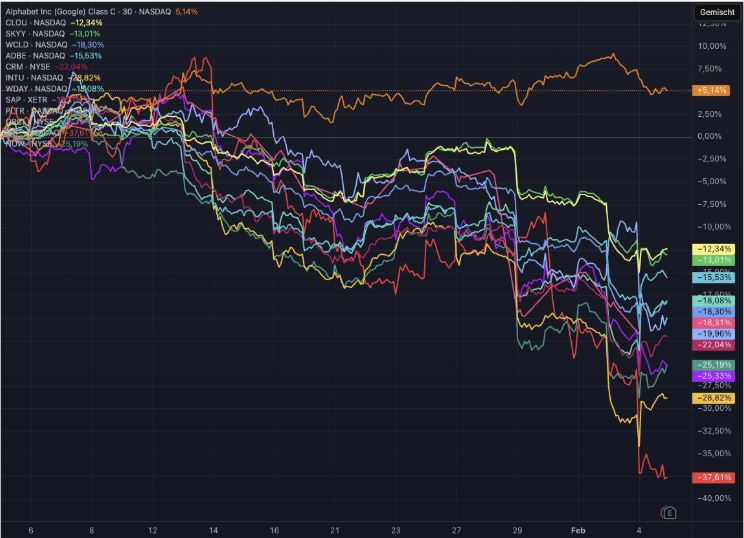
Source: Trading View
How Anthropic's coding agent is rattling a trillion-dollar software industry—and why your ops team should be paying very close attention.
I've been staring at my credit card statement this week. Not for the usual reasons (though the 2 AM eBay habit remains a problem). I was counting SaaS subscriptions. The number was not flattering. And apparently I'm not alone, because the entire software industry just had its own version of the same sinking feeling—except theirs involved actual billions evaporating from stock valuations rather than a mildly depressing bank statement.
Here's what happened: Anthropic expanded Claude's automation capabilities across enterprise workflows, and the stock market responded the way my dog responds to fireworks—with immediate, visceral panic. The S&P North American Technology Software Index dropped more than 30%. One Bloomberg Intelligence analyst described software stocks as "radioactive." Which is not a word you typically want associated with your investment portfolio.
The underlying fear is beautifully simple: if an AI can build functional software from a plain-language prompt—fast, cheaply, and without a project manager scheduling a kickoff meeting to plan the planning meeting—then the economic logic that's sustained the SaaS model for a generation starts looking a bit... fragile.
The $350,000 Weekend Project (Or: Why VCs Are Losing Sleep)
Paul Ford—technologist, former software firm CEO, generally credible human—recently described building a fully functional website over a weekend using Claude. A site he estimated he would previously have paid $25,000 to outsource. His cost: $200 per month on a subscription plan. Then he casually mentioned that a complex data visualisation project he once would have scoped at $350,000 (a product manager, a designer, two engineers, four to six months) he completed in an evening. "I would have charged $350,000," he wrote, about what had become essentially a hobby project.
I read that three times. Then I looked at the invoices from our last custom tool build. Then I closed my laptop and went for a walk. (My therapist would be proud, except I spent the entire walk thinking about SaaS margins.)
And this isn't just one guy having a moment. Claude Code, Anthropic's coding agent, earned $1 billion in its first six months. That number matters less as revenue and more as a signal that demand for AI-assisted development isn't theoretical anymore. It's a commercial reality scaling at a pace that should make every software CEO slightly nauseous.
The Beautiful Mess of "Good Enough" Code
Now, here's where I can already hear the developers in the audience sharpening their pitchforks. The software being produced this way is not always clean. It would absolutely fail an enterprise quality audit. If you showed it to a senior engineer, they might actually cry.
But Ford's observation cuts right to the heart of it: "Code just has to work." Users evaluating a tool that solves their problem are not grading the underlying architecture. They care whether the report runs, whether the order gets placed, whether the dashboard updates. In most internal business applications, that bar is entirely achievable with AI-generated code.
This is the software equivalent of that IKEA furniture you assembled at midnight. Is it structurally perfect? No. Did you follow all the instructions? Absolutely not. Is it holding your books up right now? Yes. Good enough.
Your SaaS Stack Is Sweating (And It Should Be)
For those of us in ecommerce who've assembled what I affectionately call "the subscription lasagne"—layer upon layer of inventory management, customer support tooling, reporting dashboards, review aggregation, pricing systems, each with its own login and its own monthly invoice—this is where things get properly interesting.
Anthropic positions Claude as a connective layer that can interface with your existing business systems, rendering interfaces directly within Claude rather than requiring you to tab-switch between nine different platforms like some kind of digital plate spinner.
Which is commercially diplomatic framing for something much more disruptive: if Claude can query your Shopify data, summarise your ad performance, draft your customer responses, and flag your lowest-margin SKUs from a single interface, the case for maintaining five separate SaaS subscriptions weakens with every capability update. (Except the SaaS companies are charging you $49/month per gadget, so they'd really prefer you didn't think about this too hard.)
So What Does This Actually Mean for Ecommerce Teams?
Right, let's set aside the investor carnage for a moment. I know watching SaaS stocks crater is entertaining in a "watching someone else's house burn down" kind of way, but the question I keep coming back to is: what does this shift actually mean for teams like ours?
And the honest answer is: it's early. We're at the "this is clearly something" stage, not the "here's your twelve-step implementation guide" stage. But the direction of travel is hard to ignore.
The software industry has historically operated on a simple premise: building custom tools is expensive and complicated, so you'll pay us a monthly subscription for a generic version that gets you 70% of the way there. And we did. Happily. Because the alternative was hiring a developer or learning to code yourself, and nobody had time for either.
What's shifting—slowly, messily, but perceptibly—is that the cost and complexity barrier is dropping. Fast. The idea that a non-technical team member could describe a business problem in plain language and get back something functional is no longer science fiction. It's not yet science fact for most of us either, if we're being honest. But it's somewhere in that uncomfortable middle ground where you can feel the ground moving even if you're not sure where it's heading.
The Opportunity Nobody's Talking About (Because It's Not Sexy Enough)
Here's what I find most interesting, and it's not the headline-grabbing "SaaS is dead" stuff. It's quieter than that.
Every ecommerce team I've ever worked with has a version of the same problem: there's a gap between the tools they have and the tools they need. You know the gap. It's the one filled with spreadsheets, manual workarounds, and that one person who somehow became the unofficial "I'll just build a formula for it" hero. (Every team has one. They are underappreciated and they are tired.)
The promise of AI-assisted development isn't that it replaces your software stack overnight. It's that it might start closing those gaps—the weird, specific, only-relevant-to-your-business gaps that no SaaS company will ever build a product for because the addressable market is approximately seventeen people.
For Amazon sellers specifically, the potential is interesting because so much of what we do is structured, repetitive, and data-driven. Tracking suppressed listings, reconciling FBA fees, monitoring ad spend across campaigns—these aren't creative problems. They're information-processing problems. And information processing is exactly what AI is annoyingly good at.
Whether we're actually at the point where your ops manager can describe a problem to Claude and get back a working tool by lunch... I think that depends on the problem, the person, and how comfortable you are with software that a senior developer would describe as "functional but aesthetically distressing." But the trajectory is clear, even if the timeline isn't.
The Part Where I Resist Making Sweeping Predictions (Mostly)
Look, I've been writing about AI long enough to know that the gap between "technically possible" and "actually happening in your business" is roughly the size of the Grand Canyon, filled with implementation details and at least one team member who will insist that their spreadsheet system is "actually fine."
The software industry isn't going away. Microsoft has survived roughly 400 predicted extinction events and their stock is up 789% over the decade. The SaaS companies with genuine defensible value—deep integrations, proprietary data networks, years of embedded institutional knowledge—will adapt. The ones whose primary value proposition is "a nice interface for something an AI can now do"... well, that's a harder conversation.
But here's what I do think is worth paying attention to: for the first time, the ability to build custom internal tools is drifting within reach of teams that previously had no path to it. Not perfectly. Not without oversight. Not without the kind of critical thinking that no AI can substitute for. But the door is opening in a way it simply wasn't two years ago.
And if you're running an ecommerce operation held together with spreadsheets, browser tabs, and sheer willpower—which, statistically, you almost certainly are—that's worth at least a raised eyebrow and a few hours of experimentation.
The Bottom Line for Sellers
We're in the early innings of a shift that could meaningfully change how ecommerce teams build and use internal tools. The technology is moving faster than most of us expected. And the opportunity for operators—particularly those with the patience to experiment and the judgment to know what's useful versus what's just shiny—is real, even if it's still taking shape.
I'm not going to tell you to cancel all your subscriptions and start vibe-coding your replacement stack this weekend. (Though if you do, please send me screenshots. I need content.)
But I am going to tell you that the question "could we build this ourselves?" is no longer automatically answered with "absolutely not, are you insane?" And for those of us who've been quietly cursing our tool stack for years, that's a pretty exciting development. Even if we're not entirely sure what to do with it yet.
Do You Love The AI For Ecommerce Sellers Newsletter?
You can help us!
Spread the word to your colleagues or friends who you think would benefit from our weekly insights 🙂 Simply forward this issue.
In addition, we are open to sponsorships. We have more than 65,000 subscribers with 75% of our readers based in the US. To get our rate card and more info, email us at [email protected]
The Quick Read:
Google and Meta are hard-wiring AI into email, search and social with no real opt-out, turning chats into hyper-personalized ads and even dynamic pricing, quietly reshaping the internet into an algorithm-run marketplace users barely control.
In a four-day MBA sprint, students used Claude, ChatGPT and Gemini to build near-real startups, showing the new edge isn’t coding but managing AI agents with clear briefs, sharp evaluation and elite delegation.
OpenAI’s first Jony Ive-designed AI device is delayed to 2027, drops the “io” name after legal pressure, and promises a pocket-sized, screen-free companion Altman calls the coolest tech ever built.
Claude Cowork shifts AI from chat to action, organizing files, building reports and executing desktop tasks inside a controlled VM, turning prompts into approved workflows and operational agents.
Meta’s Lattice unifies ad delivery across all surfaces, lifting performance while shifting the edge from Ads Manager tweaks to signal quality, first-party data and creative that better trains the algorithm.
The Tools List:
🪄 Magic Documents: Organize, rename, summarize, and extract key data from any document with AI.
⁉️ My Ask AI - Let AI answer 75% of customer support emails.
👨💼 KPI Builder - Discover the most crucial Key Performance Indicators (KPIs) for founders.
📊 Myko - Unlock hidden sales insights with AI.
⚙️ D-ID Agents - Create and deploy digital people that work for you.
📧 Inbox Zero- Open-sourced AI email clean-up management
🤖 Coze - No-code creation and deployment of advanced AI chatbots
About The Writer:

Jo Lambadjieva is an entrepreneur and AI expert in the e-commerce industry. She is the founder and CEO of Amazing Wave, an agency specializing in AI-driven solutions for e-commerce businesses. With over 13 years of experience in digital marketing, agency work, and e-commerce, Joanna has established herself as a thought leader in integrating AI technologies for business growth.
For Team and Agency AI training book an intro call here.