- AI for Ecommerce and Amazon Sellers
- Posts
- Amazon Wants to Sell Ads Inside Your AI Conversations
Amazon Wants to Sell Ads Inside Your AI Conversations
Why Amazon, Criteo, and The Trade Desk Are Fighting Over Conversations You Haven't Had Yet

Jo Lambadjieva
March 11, 2026
In partnership with


From Our Sponsor:
You Can't Automate Good Judgement
AI promises speed and efficiency, but it’s leaving many leaders feeling more overwhelmed than ever.
The real problem isn’t technology.
It’s the pressure to do more with less — without losing what makes your leadership effective.
BELAY created the free resource 5 Traits AI Can’t Replace & Why They Matter More Than Ever to help leaders pinpoint where AI can help and where human judgment is still essential.
At BELAY, we help leaders accomplish more by matching them with top-tier, U.S.-based Executive Assistants who bring the discernment, foresight, and relational intelligence that AI can’t replicate.
That way, you can focus on vision. Not systems.
The Chatbot Ad Gold Rush
For roughly twenty years, ecommerce advertising has operated on terrain we mostly understood. Search ads, display networks, social platforms, retail media — the plumbing was complex, occasionally leaky, but fundamentally mapped. We knew where the pipes went. We knew who was paying for the water.
That comfortable era is now getting a structural renovation nobody asked for, because the surface where consumers discover products is no longer a page, a feed, or a results list. It's a conversation. And naturally, the moment a new surface appears where humans pay attention, the advertising industry shows up like seagulls at a beach picnic.
The Opening Moves (And There Have Been a Lot of Them)
The past few weeks have been busy. OpenAI started testing ads inside the free and lower-priced tiers of ChatGPT, with a casual minimum buy-in of $200,000 — which is either a "pilot programme" or "the world's most expensive beta test," depending on how charitable you're feeling. Criteo jumped in as the first ad tech company formally integrated into that test. Then reports surfaced that OpenAI had held preliminary talks with The Trade Desk about a potential partnership, and The Trade Desk's stock promptly shot up 18% in a single session. (The stock is still more than 50% below its 52-week high, but details like that tend to get lost in the excitement.)
And then, because no party is complete without the biggest kid on the block showing up uninvited, Amazon reportedly started exploring the creation of an ad network specifically designed to serve ads inside third-party AI chatbot interfaces. Pinterest was cited as a potential early client, which is the kind of sentence that would have made zero sense eighteen months ago but now barely raises an eyebrow.
Individually, each of these moves is incremental. Together, they describe an industry speed-running the construction of an entirely new advertising channel — while simultaneously having no idea how to measure whether any of it actually works.
The Programmatic Déjà Vu
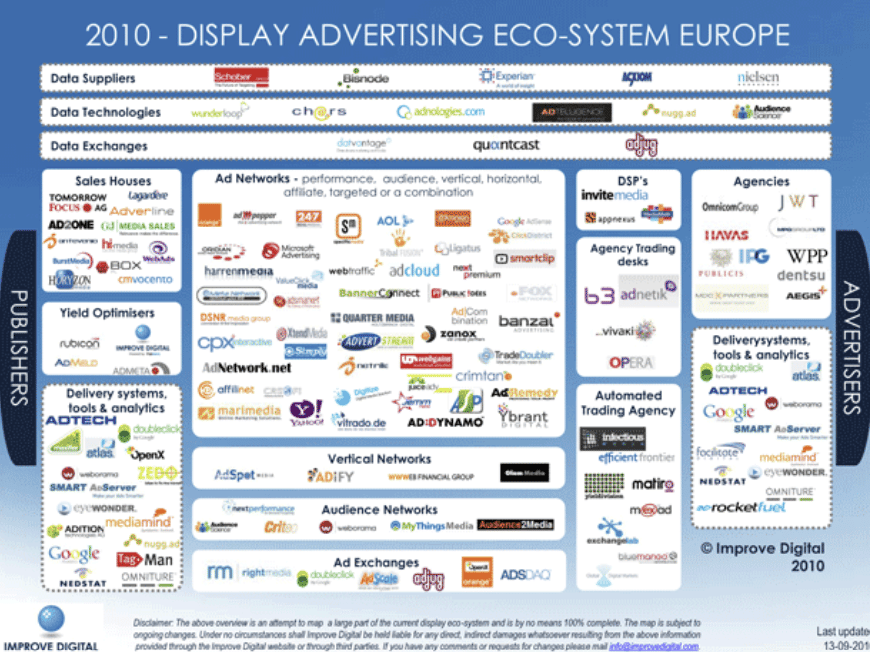
Is AI going to see similar faith?
The structural parallel that keeps coming up in every conversation about this is the early programmatic era. Late 2000s, early 2010s — demand-side platforms started automating display inventory purchases, the technology moved faster than anyone could build measurement norms around it, and ad spend followed audience scale with a kind of faith-based optimism that, in retrospect, was adorable.
Chatbot advertising has a recognisably similar shape. Large and growing user base? ChatGPT reportedly has 900 million weekly active users, the vast majority sitting on the free tier where ads will appear. Nascent monetisation infrastructure? Check. Fundamental questions about how value is created and measured that nobody has resolved? Very much check.
Criteo has reported that shoppers referred from a chatbot to a retailer website convert at roughly 1.5 times the rate of other referral channels. Before anyone starts reallocating budgets, that figure comes from one month of data, from a self-selected test environment, during a period when the people using ChatGPT for shopping recommendations are almost certainly not representative of mainstream consumer behaviour. It's a data point, not a conclusion. (The history of early-stage channel metrics is essentially a graveyard of numbers that looked incredible in month one and mediocre by month twelve.)
But the underlying thesis is plausible: someone who actively asks a chatbot to help them find a product has already done a degree of consideration work that a display ad simply can't replicate. The intent signal is structurally higher. Whether that intent signal survives the transition from organic to commercially mediated conversation is the question everyone's tiptoeing around.
Amazon: From Retail Media King to… Everyone's Ad Server?
Amazon's reported move into third-party chatbot advertising is less interesting for what it is than for what it implies. Amazon has spent years building one of the most sophisticated retail media networks in existence — tens of billions in annual ad revenue, generated by monetising the intent signals of its own shopping audience. Extending that model outward into other platforms' chatbot interfaces would essentially position Amazon as the demand aggregator for the entire emerging channel.
Think Google AdSense, but for conversations. AdSense succeeded because publishers needed a way to monetise traffic without building their own sales infrastructure. The chatbot equivalents — Pinterest's AI shopping assistant, embedded assistants across publisher sites, dedicated AI search products — face the exact same structural problem. They have users. They have conversational surfaces where ads could plausibly appear. What they don't have is the demand relationships and measurement tooling to monetise those surfaces on their own.
For Amazon sellers, this creates a scenario that's simultaneously promising and migraine-inducing. If Amazon's ad tech increasingly intermediates product discovery across third-party chatbots, you might gain new surfaces to reach customers. You'll also gain new attribution headaches that make the current multi-channel measurement debates look quaint. A consumer discovers a product via a Pinterest AI assistant, gets served a sponsored result through Amazon's network, clicks through, converts — that journey runs through multiple attribution systems, each with competing claims on the conversion event.
The Attribution Problem (Which Is Actually a Philosophy Problem)
The attribution challenge at the centre of chatbot advertising isn't a technical problem waiting for clever engineering. It's a structural feature of how conversations work.
When someone asks ChatGPT to recommend a product and the chatbot surfaces a sponsored result alongside organic recommendations, the question of what caused the purchase is genuinely ambiguous. The chatbot created the discovery context. The ad secured the click. The retailer closed the sale. Everyone in that chain has a credible claim and a commercial incentive to assert it as broadly as possible.
This mirrors the multi-touch attribution debates that plagued digital advertising for years, but compressed. And with an added wrinkle: in a chatbot interface, the platform controlling the conversation has far more influence over how products are framed than a publisher ever had over a banner placement. The contextual signals and the commercial signals are tangled together in ways that existing measurement frameworks were never designed to handle.
For sellers, this isn't abstract. If chatbot-referred conversions carry inflated attribution claims — and early-stage channels historically always carry inflated attribution claims — then budgets allocated on the basis of those numbers may not survive contact with a properly constructed incrementality test. We've seen this film before with retail media and social commerce. The opening weekend numbers were spectacular. The long-term box office was more complicated.
The Trust Problem Nobody Wants to Have
There's one dimension of chatbot advertising that has no real parallel in previous channel developments, and it's worth sitting with for a moment.
Perplexity — the AI search tool — recently reversed course on its advertising push because ad placements were undermining user confidence in the neutrality of its responses. Their user base is a fraction of ChatGPT's, which may explain why OpenAI appears less concerned. Scale provides a partial buffer: more advertisers competing, better targeting data, lower probability that any individual user feels like they're being sold to constantly.
But the underlying tension doesn't resolve with scale. It potentially gets worse. The entire commercial proposition of a conversational AI assistant rests on the perception that its recommendations serve the user's interest. Advertising, by definition, introduces a competing interest. How that tension is managed — through labelling, placement frequency, relevance thresholds — will determine whether chatbot advertising becomes a durable channel or just reproduces the slow trust erosion that turned social feeds and search results into something most of us navigate with low-grade suspicion.
The programmatic display ecosystem offers a useful cautionary tale here: the same infrastructure that enabled precise targeting also enabled the ad fraud, brand safety failures, and inventory proliferation that spent years undermining the whole channel's credibility. The technology was brilliant. The incentive structures were not.
What This Actually Means for Sellers Right Now
Here's the honest answer: probably not much, yet. The minimum spend thresholds for OpenAI's pilot alone put it beyond reach for most Amazon sellers and mid-market brands. The measurement infrastructure is embryonic. The attribution frameworks are contested. The user experience norms haven't stabilised.
None of what's happened in the past few weeks — Criteo's integration, The Trade Desk discussions, Amazon's reported exploration — constitutes a channel you can evaluate on the same terms as an existing retail media or social commerce investment.
What this moment does require is paying attention with structure. Not whether chatbot advertising will exist at scale — the commercial pressures on OpenAI, the strategic interests of Amazon and established ad tech firms, make that outcome near-certain. The questions worth tracking are how measurement gets standardised, which platforms control the demand relationships, and whether the consumer intent signals that make chatbot traffic theoretically valuable survive the introduction of money into the conversation.
Those answers are coming. They're not here yet. But the companies positioning themselves now — through early integrations, exploratory network-building, incrementality measurement development — are placing bets that will define the competitive landscape of AI-mediated advertising for years.
For the rest of us, the job right now is comprehension, not participation. Understanding the structural logic well enough that when this channel reaches a scale that warrants a budget decision, you're making that decision with clarity rather than hype.
That moment is getting closer. And it's bringing a $200,000 minimum spend with it.
Do You Love The AI For Ecommerce Sellers Newsletter?
You can help us!
Spread the word to your colleagues or friends who you think would benefit from our weekly insights 🙂 Simply forward this issue.
In addition, we are open to sponsorships. We have more than 35,000 subscribers with 75% of our readers based in the US. To get our rate card and more info, email us at [email protected]
The Quick Read:
Rippling is winning AI search by publishing competitor FAQs like “Is Gusto a PEO?”, letting AI tools cite their content and inject the brand directly into buyer evaluation conversations.
Anthropic just launched a full Claude learning hub with courses on AI fluency, Claude Code, MCP, and building with the Claude API for developers, educators, and teams.
Early reports show ChatGPT ads may work through contextual recommendations inside conversations, with invite-only campaigns starting around a $200K commitment and a premium $60 CPM model.
Claude Cowork is proving powerful for data-heavy strategy work, letting teams combine CRM data, transcripts, and research into a single context window to generate deep ICP analysis in hours.
Voice mode is rolling out to Claude Code, letting users speak prompts directly into the editor with push-to-talk while mixing voice and typing in the same workflow.
OpenArt has launched Bot House, a reality show featuring six AI influencers competing in challenges where the only rule is simple: go viral or get deleted.

The Tools List:
🖥️ Azna - Turn ideas into personalized AI copilot apps without coding.
📹 Vidu 2.0 - A new video model with improved subject consistency and three resolution options up to 1080p.
🖊️ Outrank finds untapped keywords and automatically publishes daily SEO-optimized blog posts to grow your website's traffic.
🌐 Keak - It automatically generates concrete website variations, tests their effectiveness, and improves your measurable results seamlessly.
🤖 Browser Use - We enable AI to control your browser.
About The Writer:

Jo Lambadjieva is an entrepreneur and AI expert in the e-commerce industry. She is the founder and CEO of Amazing Wave, an agency specializing in AI-driven solutions for e-commerce businesses. With over 13 years of experience in digital marketing, agency work, and e-commerce, Joanna has established herself as a thought leader in integrating AI technologies for business growth.
For Team and Agency AI training book an intro call here.