- AI for Ecommerce and Amazon Sellers
- Posts
- Amazon's "Buy For Me" Debacle
Amazon's "Buy For Me" Debacle
When the Platform That Hates Scrapers... Becomes the Scraper

Jo Lambadjieva
January 21, 2026

From Our Sponsor:

⚡ 17 Badass Amazon hackers are gathering for a badass showdown!
Each speaker will share a hack in 5 mins! Let's see … WHO is the BEST OF THE BEST!
Amazon's "Buy For Me" Debacle: When the Platform That Hates Scrapers... Becomes the Scraper
Okay, we need to talk about the absolute audacity happening in agentic commerce right now. And I promise this isn't just me being dramatic at 1 AM again (though, full disclosure, it is 1 AM and I am being at least a little dramatic).
Amazon—the company that has spent the last year aggressively blocking AI agents from touching its platform, suing Perplexity over their Comet browser, and basically treating any third-party crawler like a home intruder—has launched a feature where its own AI agent scrapes independent retailers' websites to buy products on behalf of Amazon customers.
The irony is so thick you could spread it on toast.
The "Surprise, You're Part of Amazon Now" Experience
Here's what's happening: Amazon has this thing called Shop Direct with a "Buy for Me" feature. When customers search for stuff in the Amazon app, they might see products from third-party websites—your Shopify store, my friend's stationery shop, that indie brand you love. And for some of these products, there's a shiny "Buy for Me" button that lets Amazon's AI agent complete the purchase without the customer ever leaving Amazon's ecosystem.
Sounds convenient, right? Here's the thing nobody seems to have told the actual retailers: they never signed up for this.
Bobo Design Studio's CEO Angie Chua found out her company was participating in this program the way nobody wants to find out anything—by suddenly receiving orders from email addresses ending in "buyforme.amazon." Her Instagram post about it went absolutely nuclear (500,000+ views), and more than 180 other small business owners reached out saying "wait, that's happening to ME too?"
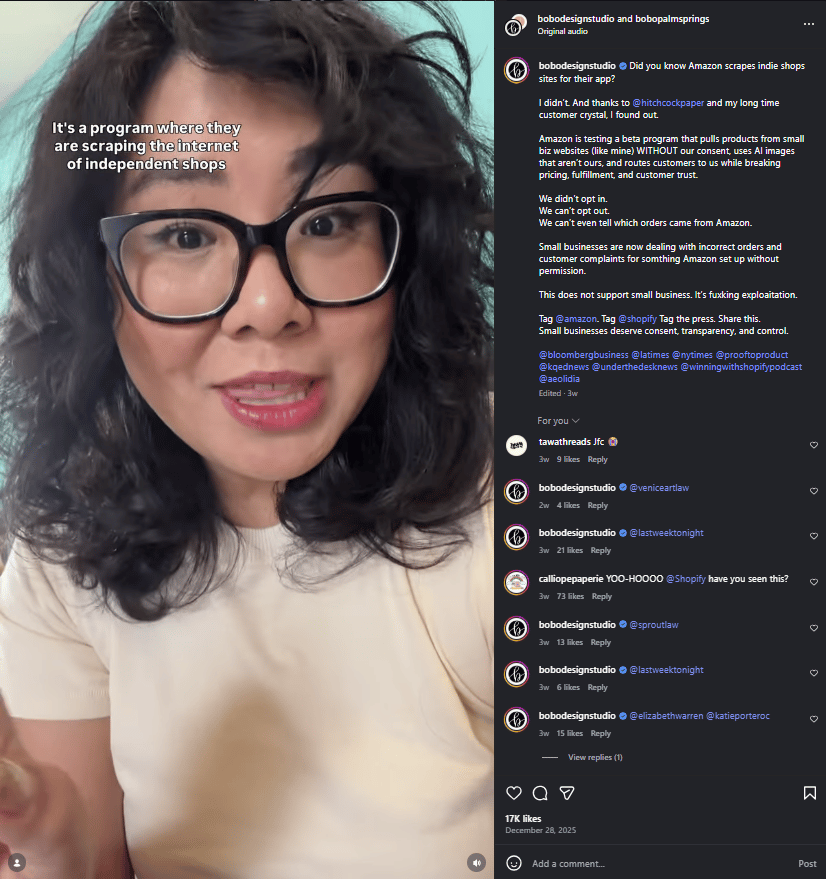
This is like finding out you've been enrolled in a gym membership by someone who also gets to use your credit card. Except the gym is Amazon and the credit card is... also yours, somehow.
The Technical Implementation Is... Not Great
So you'd think if you're going to unilaterally conscript businesses into your AI commerce experiment, you'd at least make sure the system actually works, right?
Narrator voice: It does not actually work.
Retailers are reporting that Amazon's system is listing products they no longer sell, using AI-modified images that don't match their actual inventory, and—my personal favorite—selling products that businesses have literally never carried. Hitchcock Paper, a Virginia stationery shop, started getting orders for stress balls. They don't sell stress balls. They have never sold stress balls. (Though I imagine the owners needed a few after dealing with this situation.)

These aren't edge cases. These are fundamental "the robot doesn't know what it's doing" errors that break the entire premise of automated commerce. If I wanted to buy something that doesn't exist using modified photos and incorrect pricing, I could just doom-scroll Temu at 3 AM like a normal person.
The Hypocrisy Is Just Chef's Kiss
Here's where this gets genuinely fascinating (and by fascinating I mean infuriating in that way where you have to laugh or you'll scream).
Remember how Amazon sued Perplexity over their Comet browser? The lawsuit alleged that Perplexity was concealing its agent's identity to scrape Amazon's website without permission. Amazon called it "computer fraud" that "degrades the customer experience." They've blocked dozens of AI agents via robots.txt—crawlers from Google, Meta, OpenAI, Anthropic, basically everyone.
Amazon's whole argument was that third-party applications should "operate openly and respect service provider decisions whether or not to participate."
And then they built Buy for Me. Which scrapes retailer websites. Without asking. Using only publicly available information. With an opt-OUT mechanism that requires you to first discover you've been enrolled and then email them to get removed.
Do you see the problem? Do you see it??
It's giving "rules for thee but not for me" energy. It's giving "we wrote these rules specifically to protect us but they shouldn't apply when we do the exact same thing." The asymmetry is so explicit it almost feels like performance art.
The Legal Time Bomb Nobody's Talking About
Okay, here's where things get really interesting from a "Amazon's lawyers are probably stress-eating right now" perspective.
There's this thing called Section 230 of the Communications Decency Act—basically the legal backbone that lets platforms exist without being sued into oblivion every time a user posts something problematic. The deal is simple: if you're just hosting or displaying content that someone else created, you're generally not liable for it. You're the bulletin board, not the person who wrote the flyer.
But here's the catch (there's always a catch): Section 230 protection disappears when a platform crosses the line from "hosting content" to "creating or developing content." Courts look at whether a platform "materially contributes" to what makes content problematic. The more you shape the substance—rather than just hosting, formatting, or doing neutral edits—the more you risk being treated as a co-developer. And co-developers don't get the liability shield.
Now think about what Amazon's doing with Buy for Me.
They're not just displaying seller information. They're scraping websites, using AI to modify images, rewriting product descriptions, and creating listings for products that don't even exist. Remember Hitchcock Paper and their phantom stress balls? That listing wasn't created by the seller. It was generated by Amazon's system. Amazon developed that content.
If a customer buys something through Buy for Me based on an AI-modified description that turns out to be false or misleading, the traditional "don't blame us, blame the seller" defense gets... complicated. The seller didn't write that description. The seller didn't choose that image. The seller didn't even know they were participating.
This is the kind of legal exposure that looks manageable when you're running a limited test, but scales terrifyingly fast when you're at 500,000+ products and counting.
I'm genuinely curious whether Amazon's legal team signed off on this or whether they're finding out about the details the same way the rest of us are—through viral Instagram posts from angry small business owners. (My money's on the latter, but I've been wrong before.)
Why Amazon Is Doing This (It's About Control, Obviously)
Let's put on our business strategy hats for a second. McKinsey projects agentic commerce could hit $1 trillion in U.S. retail revenue by 2030. Morgan Stanley thinks nearly half of American shoppers will use AI agents by then.
This is an existential threat to Amazon's entire business model. When consumers use ChatGPT's instant checkout or Perplexity's purchasing features, those platforms collect the transaction fees and own the customer relationship. Amazon's margin structure and advertising business literally depend on controlling that relationship.
So what do you do if you're Amazon? You try to become the universal interface for all commerce—not just products sold on your platform, but everything everywhere. If people are going to use AI agents to shop, Amazon wants to be that agent.
The feature expanded from 65,000 products at launch to over 500,000 by November. They're not slowing down despite the complications. The logic is clear: better to ask forgiveness than permission, especially when you're big enough that forgiveness is optional.
Why Small Businesses Are Furious (And It's Not Just About Consent)
The retailers pushing back aren't just mad about the lack of consent—though that's a big part of it. Some of these businesses deliberately chose not to sell on Amazon. Maybe they have philosophical objections to platform concentration. Maybe they want direct customer relationships. Maybe they just don't want to deal with Amazon.
Finding their products suddenly listed on Amazon, with AI-modified descriptions and imagery they didn't create, creates reputational risks they never agreed to take on. When Emi Moon from Peachie Kei discovered her entire catalog on Amazon through Buy for Me, she put it simply: she doesn't want her brand associated with Amazon's marketplace.
There's something particularly dystopian about a company so powerful it can forcibly associate your brand with its platform and then say "but you can email us to opt out!" As if the burden should be on the small business owner to constantly monitor whether Big Tech has decided to absorb them.
The New Normal for Operators (Unfortunately)
For those of us building on Shopify, WooCommerce, Squarespace, and similar platforms, this creates a whole new category of operational overhead nobody asked for:
You now need to monitor Amazon's marketplace to see if your products are being misrepresented
You'll get customer service inquiries about listings you didn't create
You have to navigate the opt-out process when you discover your involuntary participation
You might be fulfilling orders for products you don't actually sell, or dealing with angry customers who received something that doesn't match the AI-generated description
This is time small businesses don't have, spent fixing problems they didn't cause. It's like being assigned homework from a class you're not enrolled in.
Shopify has responded by implementing default robot/agent policy language in merchants' robots.txt files, trying to establish technical boundaries. But these only work if agents voluntarily respect them—the same courtesy Amazon demands for its own platform while apparently ignoring when convenient.
The Bottom Line
Amazon's Buy for Me experiment is basically a case study in platform power and its limits. The company is simultaneously arguing that no one should scrape their platform while scraping everyone else's, demanding consent they don't offer, and treating independent retailers as resources to be indexed rather than businesses with agency.
The question isn't whether AI agents will reshape commerce—that's already happening. The question is whether it happens through negotiated standards and mutual consent or through unilateral action by dominant platforms.
Based on what we're seeing? I'd prepare for door number two while advocating loudly for door number one.
And maybe start checking Amazon for listings of products you definitely don't sell. Just in case some AI decided you're in the stress ball business now.
Do You Love The AI For Ecommerce Sellers Newsletter?
You can help us!
Spread the word to your colleagues or friends who you think would benefit from our weekly insights 🙂 Simply forward this issue.
In addition, we are open to sponsorships. We have more than 62,000 subscribers with 75% of our readers based in the US. To get our rate card and more info, email us at [email protected]
The Quick Read:
“Next-word prediction” is old cope. Modern models solve hard problems, show risky behaviours, and act more like path-finders than autocomplete.
Google’s rolling out Gemini retail agents so brands can do AI shopping, support, and ordering inside their own apps.
2026 social forecast, short-form stays king, AR glasses edge closer, Reddit gets crowded with brands, AI slop chills sharing and more.
Rumour: OpenAI “Sweetpea” is an AirPods-style audio wearable, Jony Ive-led, premium build, big volume targets, long runway.
Veo 3.1 adds ref-image video, native vertical, 1080p to 4K, better consistency, plus SynthID watermarks.
HubSpot says semantic triples can boost AI citations fast, if you keep it human-readable and answer-first.
Amazon may open a Walmart-like mega store with app/kiosk ordering and a huge backroom for fulfilment.
AI fakes are crushing “seeing is believing,” pushing everyone into default skepticism and trust fatigue.
Adobe: AI ecommerce traffic up 693% in 2025 holidays, still small, but zero-click influence is the bigger threat.
Higgsfield hits $1.3B valuation as AI video goes mainstream for marketers, with slop risk still baked in.
Google Trends gets Gemini help, auto-suggesting related terms and prompts so research takes minutes, not hours.
The Tools List:
📹 HeyGen - Create personalized outreach videos at scale.
BrandWellAI: The All-in-One Content Marketing Platform that Drives Growth, Designed for Marketers that Care
🌐 Ayraa AI: Your personal search engine and knowledge assistant at work. Connects with Slack and your web browser to instantly capture and organizes everything you do at work.
📸 Product Descriptions GPT - Craft engaging e-commerce product listings
🪄 Magika by Google - AI-powered fast and efficient file type identification.
📧 Streak: AI-powered CRM co-pilot with data entry, precise insights, and tailored suggestions to help your team make informed decisions.
About The Writer:

Jo Lambadjieva is an entrepreneur and AI expert in the e-commerce industry. She is the founder and CEO of Amazing Wave, an agency specializing in AI-driven solutions for e-commerce businesses. With over 13 years of experience in digital marketing, agency work, and e-commerce, Joanna has established herself as a thought leader in integrating AI technologies for business growth.
For Team and Agency AI training book an intro call here.